
Winter gardens often get a bad reputation. As the days shorten and the frost sets in, many of our beloved blooms retreat underground or shed their leaves, leaving behind a landscape of bare branches and dormant earth. But your outdoor space doesn’t have to surrender to the grey skies. There is a way to inject vibrant colour and sweet fragrance into the coldest months of the year.
Enter Mahonia x media ‘Winter Sun’. This architectural evergreen shrub is a true winter warrior, offering structure, texture, and brilliant yellow blooms when most other plants are fast asleep. Whether you are an experienced horticulturist or a weekend gardener looking to spruce up a shady corner, this plant offers high impact with relatively low maintenance.
Let’s explore this striking shrub, from its botanical roots to the best ways to help it thrive in your own patch of earth.
A Beacon of Light in the Dark Months
Botanically known as Mahonia x media ‘Winter Sun’, this plant belongs to the Berberidaceae family. It is a hybrid, a cross between Mahonia japonica and Mahonia lomariifolia. While it doesn’t have a huge variety of common names, you might hear gardeners simply refer to it as “Oregon Grape” (though this usually refers to its cousin, Mahonia aquifolium) or simply “Mahonia”.
The ‘Winter Sun’ cultivar was selected for its specific, superior traits. It was raised in Northern Ireland at the Slieve Donard Nursery during the mid-20th century, specifically chosen for its upright habit and its tendency to flower earlier than other varieties.
Visually, it is a showstopper. It is an erect, evergreen shrub that brings a tropical, almost prehistoric feel to a temperate garden. The leaves are large, pinnate, and deeply divided into spiny, holly-like leaflets. These leathery, dark green fronds provide excellent architectural interest all year round.
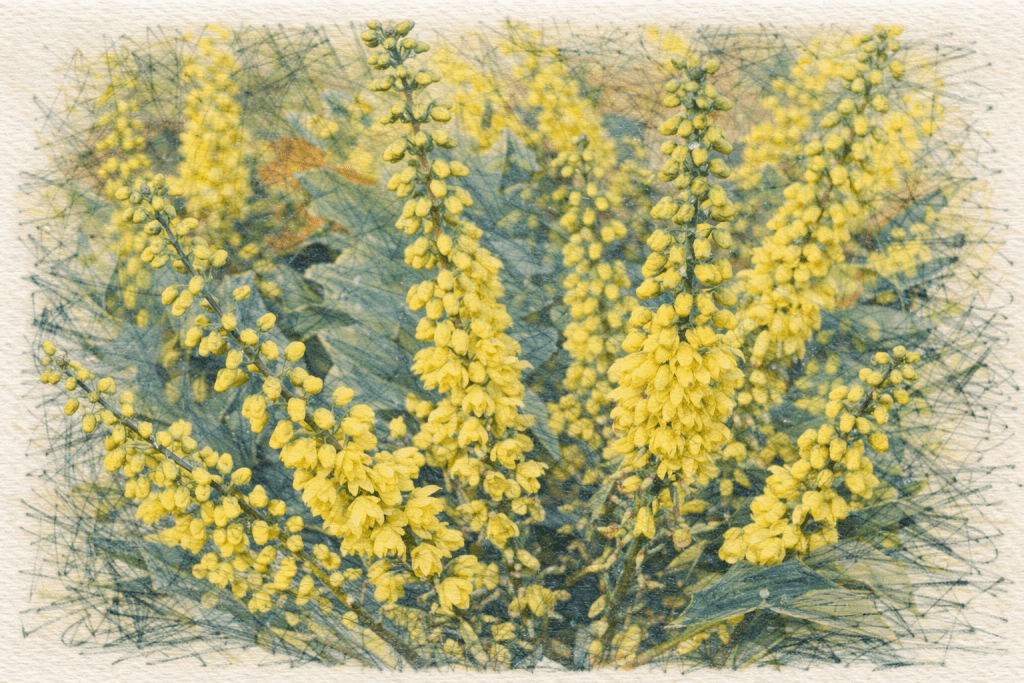
But the real magic happens from November to March. Just as the rest of the garden fades, ‘Winter Sun’ produces long, racemes (spikes) of bright, lemon-yellow flowers. These clusters fan out from the centre of the leaf rosettes like rays of sunshine—hence the name. Following the flowers, deep purple-blue berries develop, providing a feast for birds later in the year.
Why ‘Winter Sun’ Belongs in Your Garden
Choosing plants for a garden is often about balancing the seasons. We tend to overload our beds with spring bulbs and summer perennials, leaving the winter months looking sparse. Here is why you should consider making space for this Mahonia.
A Feast for the Senses
The visual impact of the yellow flowers against the dark green foliage is undeniable, but the scent is equally delightful. The flowers carry a fragrance reminiscent of lily-of-the-valley—fresh, sweet, and uplifting on a crisp winter morning. Placing it near a pathway or entrance ensures you catch this scent every time you step outside.
A Lifeline for Wildlife
Gardening is a partnership with nature. In the depths of winter, pollinators often struggle to find food sources. The nectar-rich flowers of ‘Winter Sun’ are a vital refueling station for bumblebees that venture out on milder winter days. Later, the blue-black berries are adored by blackbirds and thrushes, making this shrub a fantastic choice for a wildlife-friendly garden.
Architectural Structure
Gardens need “bones”—plants that provide structure and shape regardless of the season. With its upright growth habit and distinct, sculptural leaves, this Mahonia acts as a focal point. It works beautifully at the back of a border, providing a dark, textured backdrop for other plants, or as a standalone specimen in a woodland setting.
Planting and Care: How to Make it Thrive
Despite its exotic appearance, Mahonia x media ‘Winter Sun’ is surprisingly robust and easy to grow in the UK climate. However, like any plant, it has its preferences.
Size and Space
This is not a small plant. It is vigorous and upright, eventually reaching a height of around 3 to 4 metres (10-13 feet) and a spread of 2 to 3 metres (6-10 feet). It requires room to stretch out. Avoid cramping it into a tiny pot or a narrow bed where its spiny leaves might snag passersby. It is best suited to the back of a large border or a dedicated shrubbery.
Sunlight and Position
One of the greatest assets of Mahonia is its tolerance for shade. It thrives in partial shade to full shade, making it the perfect solution for those tricky, darker corners of the garden where sun-loving plants fail.
While it can tolerate some sun, it prefers shelter from harsh, drying winds and direct midday sun in summer, which can scorch its leaves. A woodland edge or the dappled shade of deciduous trees is its ideal habitat.
Soil Requirements
‘Winter Sun’ is unfussy about soil type. It will grow in chalk, clay, loam, or sand, provided the drainage is good. It prefers moist, well-drained soil that is rich in organic matter.
When planting, dig a hole twice the width of the root ball. Incorporate plenty of well-rotted garden compost or manure into the excavated soil to give it a nutrient-rich start. Water it well after planting and keep it hydrated during dry spells for the first couple of years until it is fully established.
Pruning
Pruning is generally minimal. You may want to remove any dead or damaged branches in spring (April or May) after the flowering has finished. If the plant becomes leggy or bare at the base—a common occurrence as Mahonias age—you can cut the tallest stems back hard to a strong set of leaves to encourage bushy regrowth from lower down. This technique, known as renewal pruning, keeps the plant looking full and healthy.
Folklore and Alternative Uses
While Mahonia x media is a modern horticultural hybrid, the genus Mahonia carries a history rich in utility and story.
The genus is named after Bernard McMahon, an Irish-American horticulturist who was one of the stewards of the plant collection from the famous Lewis and Clark expedition in the early 19th century.
In folklore, plants with spiny leaves like holly and Mahonia were often planted near houses to ward off evil spirits or lightning—though for Mahonia, this is likely a borrowed association due to its holly-like appearance.
Historically, indigenous peoples in North America used the roots and bark of the related Mahonia aquifolium (Oregon Grape) for medicinal purposes. They utilized it to treat various ailments, including stomach issues and skin conditions. The roots contain berberine, a compound known for its antimicrobial and anti-inflammatory properties. The berries of Oregon Grape were also used to make jelly and wine, though they are quite tart.
While you shouldn’t go digging up your ‘Winter Sun’ for medicinal experiments, the berries are technically edible, though very acidic and filled with seeds. They are best left to the birds, who appreciate them far more than our palettes would!
Bring the Winter Sun Home
Gardening is a year-round joy, not just a summer pastime. By introducing Mahonia x media ‘Winter Sun’ into your landscape, you ensure that even the darkest days are punctuated with flashes of gold and sweet scent.
It is a resilient, architectural beauty that asks for little but gives so much in return. Whether you are looking to support early bees, fill a shady void, or simply enjoy flowers in January, this plant is a worthy addition to your green space.
So, wrap up warm, grab your spade, and invite a little sunshine into your winter garden.
Further Reading: Helleborus niger: The Star Plant That Brightens the Winter Garden, Why Witch Hazel ‘Jelena’ Is the Winter Wonder Your Garden Needs, The Winter Garden: Winter Interest Shrubs
Inspiration: Follow Us on Instagram, Threads, BlueSky, Twitter, TikTok and Pinterest.