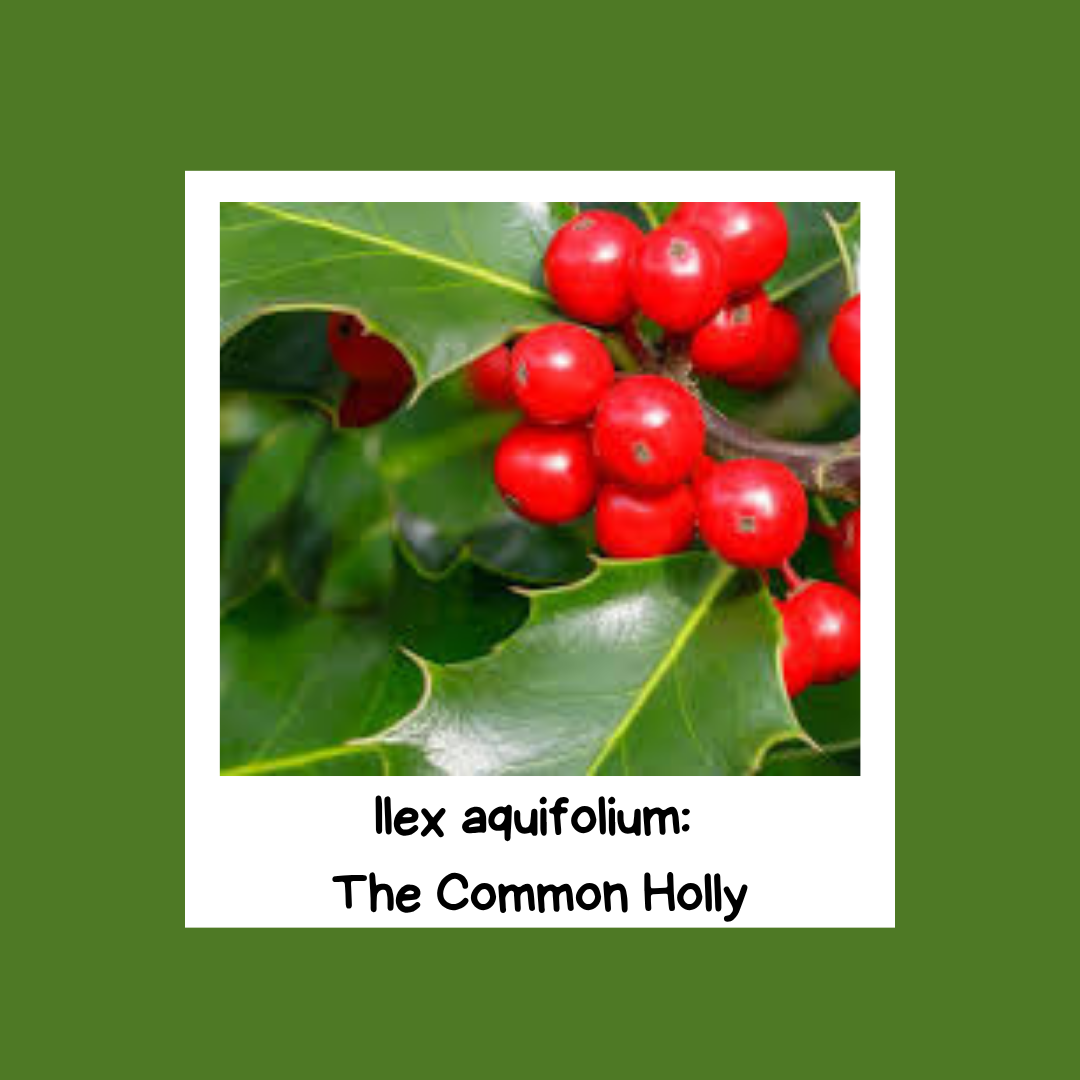
The common holly, or Ilex aquifolium, is one of Britain’s few native evergreen trees. Instantly recognisable by its glossy, spiny leaves and vibrant red berries, it is a plant deeply woven into the country’s landscape and cultural heritage. It is a frequent sight in woodlands, hedgerows and gardens, valued for its ornamental appeal and its importance to wildlife.
A Description of Common Holly
Ilex aquifolium is a slow-growing, medium-sized evergreen tree or large shrub, typically reaching heights of 10–15 metres, although it can occasionally grow taller. The bark is smooth and silvery-grey, becoming more fissured with age.
The most distinctive feature of the holly is its leaves. They are dark green, thick and leathery with a high-gloss finish on the upper surface. The shape is ovate or elliptical, and the margins are famously spiky, particularly on the lower branches of the plant. These spines are a natural defence mechanism against browsing animals. Leaves on the upper branches, which are out of reach of deer and other herbivores, often have smoother edges.
Ilex aquifolium is dioecious, meaning male and female flowers are produced on separate plants. The flowers are small, white, and have four petals. They appear in late spring and are often inconspicuous, clustered in the leaf axils. For the iconic red berries to form, a female plant must be pollinated by a nearby male plant. These berries, known as drupes, ripen in late autumn and persist throughout the winter, providing a stark, beautiful contrast against the dark green leaves and often a snowy backdrop.
Seasonal Interest of Holly
One of the greatest assets of Ilex aquifolium is its year-round appeal. Its structure and colour provide interest in every season.
- Spring: In late spring, from April to May, the holly produces its small, white, sweetly scented flowers. While not visually spectacular, they are attractive to pollinators like bees and hoverflies. New leaf growth also appears at this time, often a lighter, brighter green.
- Summer: During the summer months, the holly serves as a dense, structural evergreen. Its glossy leaves provide a lush, dark green backdrop for other, more colourful summer-flowering plants in the garden. If pollination was successful, tiny green berries begin to form.
- Autumn: As autumn progresses, the berries on female plants ripen, changing from green to a brilliant scarlet. This provides a vibrant splash of colour just as many other plants are beginning to die back for the winter.
- Winter: It is in winter that the holly truly stands out. The combination of its evergreen leaves and bright red berries offers vital colour and life in the dormant garden. This makes it a popular choice for winter displays and, of course, for traditional Christmas decorations. The berries also become a critical food source for birds when other food is scarce.
Benefits of Planting Ilex aquifolium
Beyond its aesthetic value, holly offers several practical and ecological benefits.
- Wildlife Support: The dense, prickly foliage provides excellent shelter and nesting sites for birds, while small mammals can find protection from predators within its branches. The flowers are a source of nectar for pollinators in spring, and the berries are a vital winter food for birds such as blackbirds, thrushes and redwings.
- Hedging and Screening: Due to its dense growth and spiny leaves, holly makes an excellent, intruder-proof hedge. It can be clipped into a formal shape or left to grow more naturally. Its evergreen nature ensures it provides an effective screen for privacy throughout the year.
- Low Maintenance: Once established, Ilex aquifolium is a very resilient and low-maintenance plant. It is tolerant of a wide range of soil types, pollution, and shady conditions, making it suitable for many different garden environments, including urban settings.
Potential Disadvantages
While a valuable garden plant, there are a few considerations to keep in mind when planting holly.
- Toxicity: The berries of Ilex aquifolium are mildly toxic to humans, and ingestion can cause stomach upset. Care should be taken if planting in areas frequented by young children.
- Spiny Leaves: The sharp spines on the leaves can make pruning and handling the plant uncomfortable without protective gloves. Fallen leaves can also be a nuisance in lawn areas or on paths.
- Dioecious Nature: To ensure a supply of berries, it is necessary to plant both male and female varieties. If space is limited, this can be a drawback. However, some self-fertile cultivars are available, such as Ilex aquifolium ‘J.C. van Tol’, which produce berries without a male pollinator.
Holly: History and Folklore
Holly has a rich history and is steeped in folklore, particularly within Celtic and Roman traditions. Long before its association with Christmas, it was considered a sacred plant by the Druids. They believed it to be a symbol of fertility and eternal life, a belief stemming from its ability to remain green throughout the winter when other plants appeared to die. It was thought to have protective powers and people would bring its branches into their homes to ward off evil spirits.
The Romans also held holly in high regard. It was associated with Saturn, the god of agriculture and harvest. During the festival of Saturnalia, a week-long celebration in mid-December, Romans would decorate their homes with holly wreaths and give them as gifts to symbolise goodwill.
With the advent of Christianity, these pagan traditions were absorbed and repurposed. The spiny leaves of the holly came to represent the crown of thorns worn by Christ, and the red berries his blood. As a result, holly became firmly established as a traditional Christmas decoration, a symbol of hope and resurrection during the darkest time of the year.
Holly: An Essential Addition to the Garden
Ilex aquifolium is more than just an attractive evergreen; it is a plant of great character, ecological importance, and cultural significance. Its ability to provide year-round structure, colour and vital support for wildlife makes it an invaluable addition to any garden.
Whether used as a standalone specimen tree, a dense security hedge, or a container plant for a patio, the common holly offers a unique combination of beauty and utility. By planting this native species, gardeners can create a visually appealing space while also contributing to the local ecosystem and continuing a tradition that stretches back for centuries.
Further Reading: Holly leaf blight, Holly leaf miner, The Holly and the Ivy Story, Camellia japonica: The Winter-Blooming Garden Essential, RHS Holly & Ivy, The Secret to Stunning Amaryllis, How to Plant a Tree
Inspiration: Follow Us on Instagram, Threads, BlueSky, Twitter, TikTok and Pinterest💚
