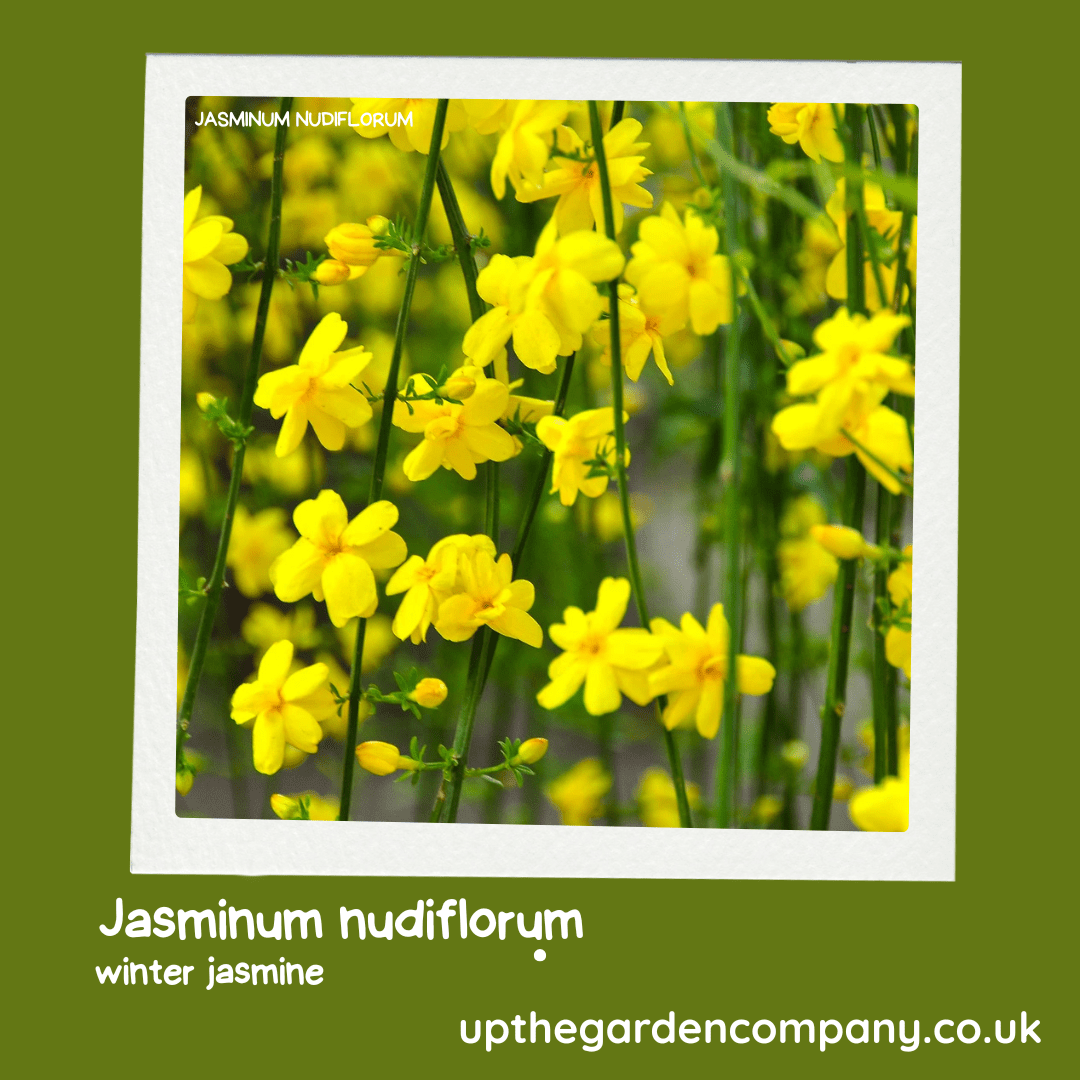
When the days grow short and frost crisps the grass, most gardens retreat into a quiet slumber. Colour fades, leaves drop, and the vibrant energy of summer feels like a distant memory. But there is one resilient beauty that defies the grey gloom of winter: Jasminum nudiflorum, commonly known as Winter Jasmine.
This cheerful shrub bursts into life just when we need it most, offering a cascade of sunshine-yellow flowers on bare, architectural stems. It is a beacon of hope in the colder months, reminding us that life continues even in the depths of winter. Whether you are an experienced horticulturist or a weekend gardener looking to add year-round interest to your plot, Winter Jasmine is a plant that deserves a spot in your soil.
A Member of the Olive Family
Jasminum nudiflorum belongs to the Oleaceae family, which makes it a distant cousin of the olive tree (Olea europaea) and the lilac (Syringa). The genus name Jasminum is derived from the Persian word ‘yasmin’, meaning ‘gift from God’—a fitting title for a plant that gifts us with such vibrancy during the bleakest season. The specific epithet nudiflorum means “naked flower,” referring to the plant’s habit of blooming on leafless stems before its foliage emerges in spring.
While many jasmines are renowned for their heady, intoxicating fragrance, Jasminum nudiflorum is unscented. Do not let this deter you; its lack of perfume is more than compensated for by its visual impact and robust constitution.
A Traveller from the East
This delightful shrub hails from China, where it grows wild on rough slopes and gullies in provinces like Gansu, Shaanxi, Sichuan, and Yunnan. It has been cultivated in Chinese gardens for centuries, appreciated for its ability to thrive in difficult conditions.
It was introduced to the Western world by the intrepid plant hunter Robert Fortune in 1844. Fortune was sent to China by the Horticultural Society of London (now the RHS) to collect exotic specimens. He spotted this yellow jasmine growing in gardens in Nanjing and Shanghai and recognised its potential immediately. Since its arrival on British shores, it has become a staple of cottage gardens and parks, beloved for its reliability and cheer.
Where to Plant Winter Jasmine
One of the greatest virtues of Jasminum nudiflorum is its unfussy nature. It is not a diva that demands perfect conditions; rather, it is a tough survivor that will make the best of what it is given. However, to see it truly flourish, try to mimic its natural preferences.
Situation and Position
Although often described as a climber, Winter Jasmine is technically a scrambling shrub. It does not have tendrils or twining stems to grip onto supports by itself. If you want it to cover a wall or fence, you will need to give it a helping hand by training it against a trellis or a system of wires.
Left to its own devices, it will form a mounded, arching shrub or scramble over banks and low walls. It is particularly effective when allowed to cascade down a slope, where its trailing stems can root where they touch the ground, helping to stabilise the soil.
Ideally, position your jasmine in full sun or partial shade. While it will tolerate deep shade, the flowering will be less profuse. A sunny, south or west-facing wall is perfect, as the warmth will encourage a spectacular display of blooms from November through to March.
Climate and Soil
This plant is fully hardy in the UK (RHS hardiness rating H5), capable of withstanding temperatures down to -15°C. It is tough enough to handle cold winds, though the delicate flowers may be damaged by severe frosts.
Regarding soil, Jasminum nudiflorum is incredibly accommodating. It thrives in well-drained soil of any pH—acid, neutral, or alkaline. It will grow in chalk, clay, sand, or loam. The only condition it truly resents is waterlogged ground, so ensure your drainage is adequate.
Cultivation and Care
Once established, Winter Jasmine is drought-tolerant and low-maintenance. Here are a few tips to keep it looking its best:
- Pruning: The best time to prune is immediately after flowering finishes in spring (usually late March or April). This gives the plant the entire growing season to produce new wood, which will carry next winter’s flowers. Cut back the flowered shoots to a strong pair of buds near the base of the old wood.
- Feeding: A generous mulch of well-rotted compost or manure in spring will help retain moisture and suppress weeds.
- Propagation: Because the stems root so easily when they touch the ground (a process called layering), you can simply detach a rooted stem and replant it elsewhere. Semi-ripe cuttings taken in autumn also strike very easily.
Stories and Folklore
While Jasminum nudiflorum lacks the specific ancient mythology attached to its scented white cousins, the Jasmine genus as a whole is steeped in lore. In the language of flowers, jasmine generally symbolises love, beauty, and sensuality. However, the yellow jasmine specifically carries associations of grace and elegance.
In China, yellow is an imperial colour, traditionally associated with the Emperor, earth, and stability. The appearance of these golden blossoms in winter is often seen as a sign of resilience and the promise of returning prosperity.
There is an old gardening adage that says, “When the jasmine blooms, the days will lengthen.” It serves as a natural calendar, its flowers heralding the slow turn of the season towards the vernal equinox.
Weighing the Pros and Cons
Every plant has its quirks. Here is why you should—or perhaps shouldn’t—choose Jasminum nudiflorum.
The Benefits
- Winter Colour: The primary reason to grow this plant. It provides colour when almost nothing else does.
- Wildlife Friendly: Early emerging bumblebees and pollinators struggling to find food in mild winters will gratefully visit the flowers.
- Versatility: Whether trained as a climber, used as ground cover, or grown as a loose shrub, it fits many garden designs.
- Toughness: Pests and diseases rarely trouble it. It is resistant to urban pollution, making it excellent for city gardens.
- Cut Flowers: Sprigs of winter jasmine cut in bud will open indoors, bringing a touch of spring into your home.
The Disadvantages
- No Scent: If you are looking for the classic jasmine perfume, you will be disappointed.
- Untidiness: Without regular pruning, it can become a tangled, woody mess. The dead stems can look scruffy and accumulate debris.
- Vigorous Growth: It grows quickly and needs to be kept in check, especially if space is limited.
Creative Uses in the Garden
Because of its habit, Jasminum nudiflorum is incredibly useful for solving tricky garden problems.
Covering Eyesores: Use it to disguise ugly structures like concrete garages, chain-link fences, or compost bins. Its dense, arching stems provide excellent coverage year-round (it is deciduous, but the green stems keep it looking verdant even without leaves).
Ground Cover on Slopes: If you have a steep bank that is difficult to mow or weed, plant winter jasmine at the top and let it cascade down. It will suppress weeds and hold the soil together.
Container Gardening: It can be grown in large pots. Place the pot on a stand or a ledge so the flowering trails can hang down, creating a weeping effect.
Combined Planting: For a stunning winter display, plant it alongside Clematis cirrhosa (which is also winter-flowering) or underplant it with winter aconites (Eranthis hyemalis) and snowdrops (Galanthus). The contrast of the yellow jasmine against the white snowdrops is classic and elegant.
Bring the Sunshine Home
Gardening is often about patience, but Jasminum nudiflorum offers immediate gratification in the seasons where we lack it most. It asks for very little—just a patch of earth and a little light—and in return, it gives us a spectacular show that defies the frost.
If your garden feels a little sad and empty this winter, why not head to your local nursery this weekend? Pick up a Winter Jasmine, get it in the ground, and watch as it turns the grey days into gold.
Further Reading: Helleborus niger: The Star Plant That Brightens the Winter Garden, The Winter Garden: Winter Interest Shrubs, Winter Planning: Design Your Dream Border for Next Year
Inspiration: Follow Us on Instagram, Threads, BlueSky, Twitter, TikTok and Pinterest.