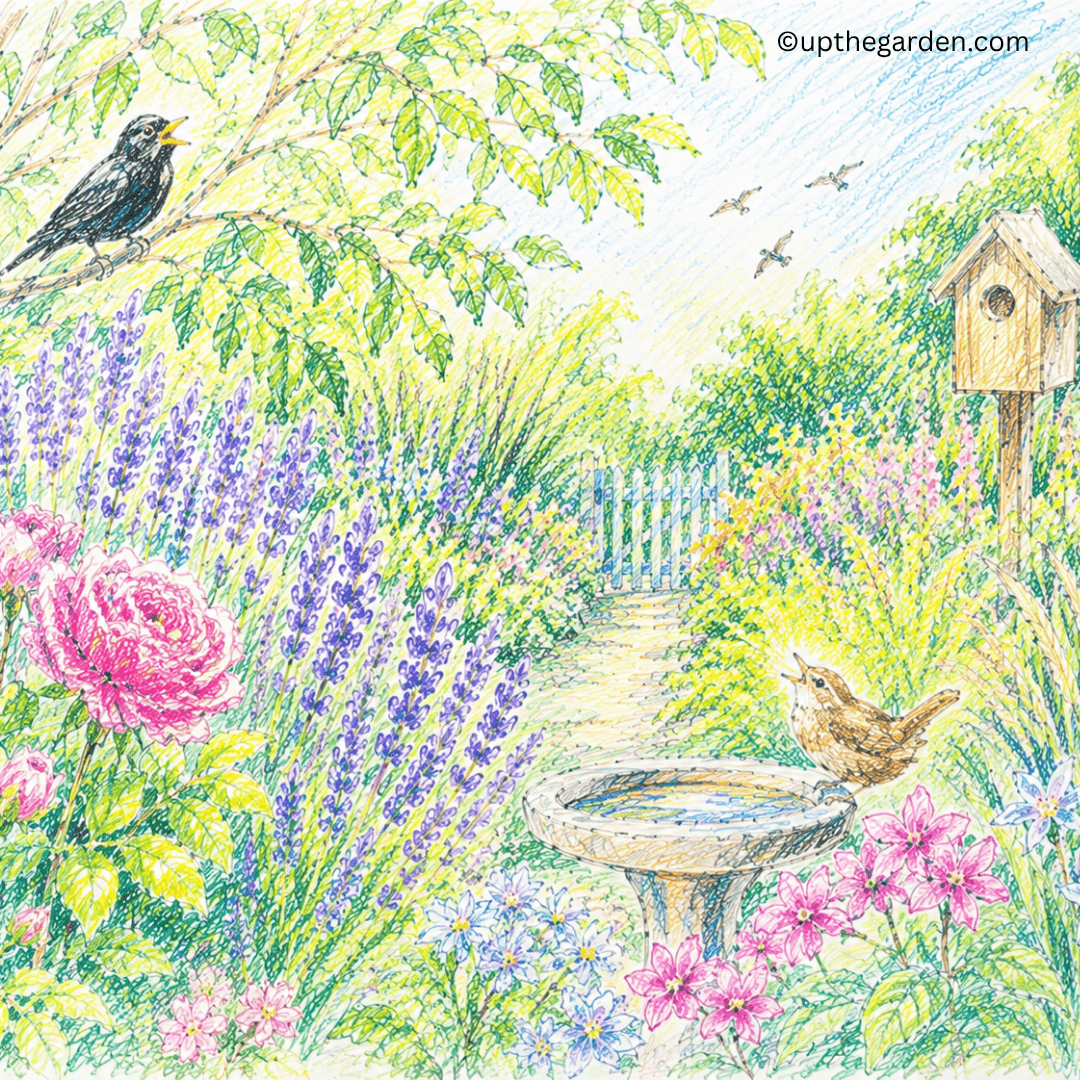
There is a curious moment that often happens when we step into a garden.
Without quite realising it, we stop talking.
Perhaps it is instinct. Perhaps it is simply because, after the clamour of everyday life, the garden has something rather more interesting to say.
Listen carefully and you’ll discover that every garden has its own voice.
Some whisper softly through ornamental grasses. Others echo with birdsong from dawn until dusk. There are gardens where water tumbles gently over worn stone, where bees hum lazily between lavender flowers, or where the wind catches the leaves of an old silver birch, creating a sound that has soothed people for generations.
It is easy to think of gardens as something we admire with our eyes.
Yet long before we notice the colours of the flowers or the shape of the borders, our ears have already begun responding.
Perhaps that is why a truly memorable garden is one that delights every one of our senses.
This is where the story begins.
The Forgotten Sense
Modern life is remarkably noisy.
Traffic, phones, televisions, machinery, notifications and conversations compete constantly for our attention. Even when we think we are enjoying peace and quiet, there is often a low hum somewhere in the background.
Gardens offer something different.
Not silence.
Something much richer.
Natural sound.
Researchers have found that listening to birdsong, flowing water and the sounds of wind moving through trees can help lower stress, improve mood and restore attention after periods of mental fatigue. Unlike sudden or mechanical noises, natural soundscapes gently encourage the brain to relax without demanding anything in return.
Perhaps this explains why we instinctively pause beside a woodland stream or find ourselves lingering beneath the branches of a mature oak.
Nature rarely shouts.
It simply invites us to listen.
The Music of Leaves
One of the most beautiful sounds in any garden arrives entirely free of charge.
A breeze.
Not a storm or a gale, but a gentle movement of air that sets the garden dancing.
Listen to the silver leaves of an olive tree, the trembling foliage of an aspen or the elegant stems of bamboo. Each creates its own distinctive rhythm.
Ornamental grasses are perhaps the greatest musicians of all.
Miscanthus, Stipa and Pennisetum sway almost constantly through summer, their soft rustling adding movement and sound even when flowers have faded. Close your eyes beside a border of tall grasses and you might easily imagine waves breaking gently upon a distant shore.
Perhaps this is why grasses bring such calm to a garden.
They remind us of landscapes far beyond our own.
Dawn’s First Chorus
Long before gardeners begin watering or weeding, another performance has already started.
The dawn chorus.
Blackbirds, robins, wrens, thrushes and songbirds each contribute their own notes to one of nature’s oldest concerts. No ticket is required. Only an early start and the willingness to stand still for a while.
Birdsong is far more than background music.
For birds, each melody marks territory, attracts a mate or strengthens family bonds. For us, however, it often signals something much simpler.
Morning has arrived.
Encouraging birds into the garden is one of the easiest ways to enrich its soundtrack.
Native hedging, berry-producing shrubs, bird baths, nest boxes and a garden managed with wildlife in mind will all invite more feathered visitors to make themselves at home.
The reward is heard every single day.
Water That Speaks
Few sounds calm the mind quite like flowing water.
Whether it is a gentle rill weaving through a border, rain dripping into a pond or a small fountain bubbling quietly beside a seating area, moving water transforms the atmosphere of a garden almost instantly.
Japanese gardens have long understood this.
Water is seldom included simply because it looks beautiful. It becomes part of the garden’s conversation, masking unwanted noise while encouraging moments of reflection.
Even the smallest water feature can soften the distant sounds of roads or neighbouring activity.
It doesn’t need to be grand.
Sometimes the quietest trickle says the most.
The Gentle Hum of Summer
Stand beside a patch of lavender on a warm July afternoon.
At first you may notice the fragrance.
Wait a little longer and another sound slowly reveals itself.
Bees.
Hundreds of them.
Their steady hum has become one of the defining sounds of summer gardens. It speaks of healthy planting, pollinating insects and flowers rich in nectar.
Planting for pollinators is not only one of the greatest gifts we can offer wildlife, but one of the simplest ways to add another gentle layer to the garden’s soundtrack.
Lavender, catmint, salvias, echinacea, verbena, alliums and foxgloves all become stages for this quiet midsummer orchestra.
When the Rain Arrives
Not every beautiful garden sound belongs to sunshine.
Rain has its own music.
Soft drops tapping against greenhouse glass.
The hollow splash of water butts slowly filling.
Leaves releasing yesterday’s dust beneath a summer shower.
Many gardeners secretly welcome gentle rain, not simply because it nourishes the soil, but because it changes the mood entirely.
The garden slows.
Colours deepen.
Fragrance intensifies.
And afterwards comes that unmistakable scent of rain on dry earth—known as petrichor—one of nature’s most evocative perfumes.
Sometimes the loveliest garden days are not the brightest.
A Place to Pause
Every sensory garden benefits from somewhere to sit.
Not simply to admire the planting.
To listen.
A weathered bench beneath an old apple tree.
A chair beside a pond.
A swing gently moving beneath a pergola.
These are not empty spaces.
They are listening places.
It is remarkable how much we hear once we stop trying to fill every quiet moment.
Even Wind Chimes Have Their Place
Wind chimes often divide opinion.
Some people adore them. Others would happily leave them on the garden centre shelf.
The secret lies in choosing thoughtfully.
A single well-crafted bamboo or copper chime placed where the breeze catches it naturally can add a delicate note to the garden without overwhelming the sounds already there.
Like every element of garden design, restraint often creates the greatest beauty.
The garden itself should always remain the main performer.
A Garden Worth Hearing
When we first begin designing a garden, it is usually flowers, colours and planting schemes that occupy our thoughts.
Rarely do we ask ourselves an equally important question.
What will my garden sound like?
Will grasses rustle beside the path?
Will birds find somewhere safe to nest?
Will bees gather among the lavender?
Will water soften the silence?
Will the breeze carry the leaves of a silver birch above a quiet seat?
Perhaps the finest gardens are remembered not only for how they looked, but for how they made us feel.
And often, that feeling began with something we heard.
So next time you step outside, pause before you pick up the trowel.
Close your eyes for just a moment.
The garden has been speaking all along.
Perhaps today is the day to truly listen.
Creating Your Own Garden Soundscape
You don’t need a grand estate to create a garden that sounds beautiful. Often, the smallest additions have the greatest effect.
- Plant ornamental grasses where the breeze can catch them.
- Include nectar-rich flowers to encourage bees and butterflies.
- Provide shrubs, hedges and nest boxes for birds.
- Add a simple bird bath or shallow water bowl.
- Consider a small fountain or bubbling water feature.
- Choose trees with musical foliage, such as silver birch or aspen.
- If you enjoy them, opt for one natural bamboo or copper wind chime rather than several.
A garden that sings softly throughout the seasons soon becomes a place you’ll never want to hurry through.
Further Reading: The Taste of the Garden, The Garden you can Touch, The Scent of the Garden, The Garden through our Eyes, The Garden for the Soul – For all the Senses
Inspiration: Follow Us on Instagram, Threads, BlueSky, Twitter, TikTok and Pinterest.