
There are few flowers as quietly evocative as the forget-me-not. Small and unassuming, yet unmistakable in its soft blue hue, it appears each spring like a gentle presence along riverbanks, hedgerows and shaded garden borders. To encounter it is often to pause, to look closer, and—true to its name—to remember.
What is a Forget-Me-Not?
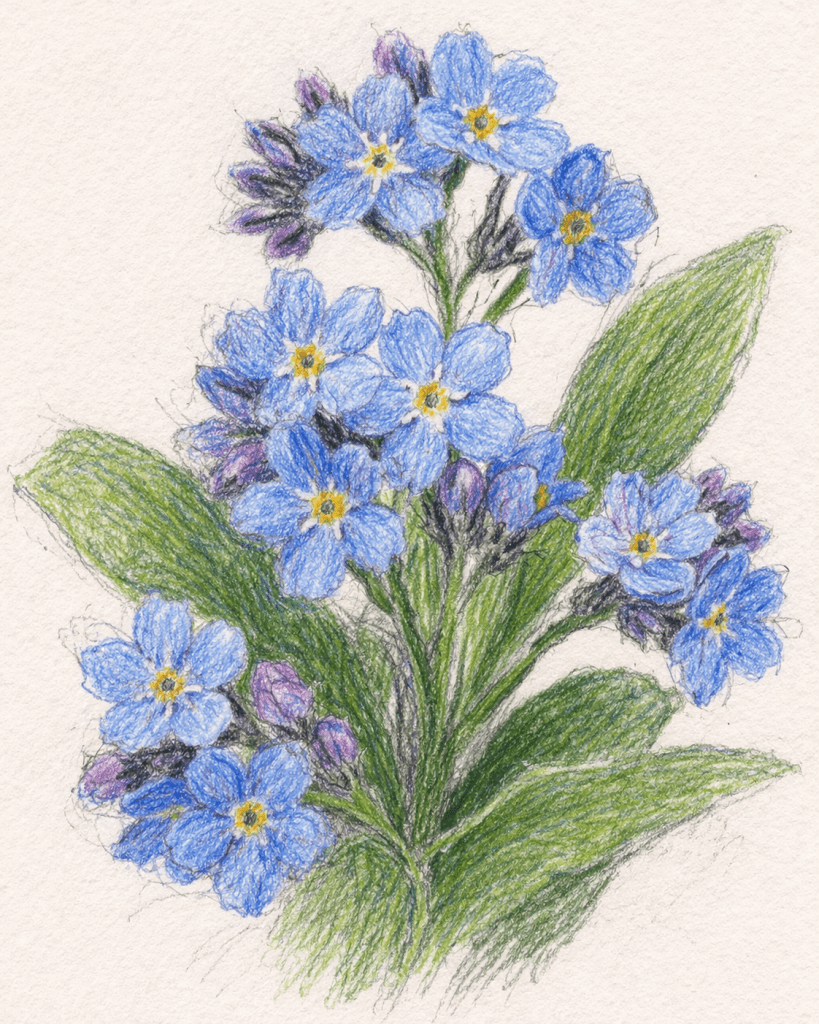
The forget-me-not is known botanically as Myosotis, a name derived from Greek meaning “mouse’s ear”, referring to the plant’s softly rounded leaves. The most familiar species is Myosotis sylvatica, commonly called the wood forget-me-not.
These delicate flowers typically feature:
- Five sky-blue petals
- A tiny yellow or white centre (“eye”)
- Soft, slightly hairy leaves
- A low-growing, spreading habit
Though blue is the classic colour, cultivated varieties also appear in pale pinks and whites. Despite their fragile appearance, forget-me-nots are hardy and prolific, often self-seeding and returning year after year.
The History of Forget-Me-Nots
Forget-me-nots have long been woven into European folklore and storytelling. One enduring legend tells of a medieval knight who, while picking the flowers for his companion beside a river, slipped into the current under the weight of his armour. As he was carried away, he threw the flowers to her, calling out, “Forget me not.”
Whether fact or fable, the story has shaped the flower’s enduring symbolism.
By the Victorian era, forget-me-nots had become firmly established in the language of flowers (floriography), where they represented:
- True love
- Remembrance
- Faithfulness
- Enduring connection
They were often exchanged between loved ones and friends as a quiet promise of lasting memory.
Forget-Me-Not Meaning and Symbolism
The meaning of forget-me-nots remains remarkably consistent across cultures and centuries. These modest blooms carry a powerful emotional message.
Common symbolic meanings include:
- Remembrance and memory
- Eternal or faithful love
- Connection across distance
- Loyalty and devotion
Today, forget-me-nots are also used in remembrance events and charitable symbols, reinforcing their association with memory and enduring bonds.
Forget-Me-Nots in Poetry and Literature
Poets and writers have long been drawn to the quiet charm of the forget-me-not. Its small size and poignant name lend themselves naturally to reflection.
“Blue and bright as lovers’ eyes,
Clinging where the brooklet sighs,
When I wander, still I see
Little flowers—forget-me-not—of thee.”
And in a more contemporary tone:
“So small a flower to hold so much,
A name that feels almost a plea;
In every petal, memory’s touch—
A whispered ‘Do remember me.’”
Uses of Forget-Me-Nots
While primarily valued for their beauty and symbolism, forget-me-nots have a handful of traditional and decorative uses.
Edible Uses
Forget-me-not flowers are considered edible in small quantities and are most often used for decoration rather than flavour.
Simple serving ideas:
- Freeze flowers into ice cubes for summer drinks
- Scatter over salads for a soft blue accent
- Use as a garnish on cakes or desserts
Their taste is mild, so their appeal lies mainly in their visual charm.
Note: Always ensure correct plant identification before consuming any flowers.
Traditional Herbal Uses
Historically, some species of Myosotis were used in folk remedies, particularly for respiratory complaints. However, these uses are largely outdated and not commonly practised today.
Modern gardeners tend to value forget-me-nots more for their aesthetic and ecological contributions than for medicinal purposes.
Gardening Uses
Forget-me-nots are a favourite in traditional and naturalistic garden designs.
Why gardeners love them:
- Thrive in partial shade
- Pair beautifully with spring bulbs such as tulips and daffodils
- Attract bees and early pollinators
- Self-seed easily for a natural look
They are especially well suited to cottage gardens, woodland edges and informal planting schemes.
Advantages and Disadvantages of Forget-Me-Nots
Advantages
- Easy to grow and low maintenance
- Ideal for beginners and experienced gardeners alike
- Excellent for pollinators
- Reliable self-seeding creates continuity
- Rich symbolic meaning
Disadvantages
- Can spread quickly and become invasive in some gardens
- Individual plants are short-lived
- Limited fragrance
- Primarily ornamental with few practical uses
Old Wives’ Tales and Folklore
Forget-me-nots have long been associated with memory, love and protection.
Some traditional beliefs include:
- Wearing the flower would ensure you are not forgotten by loved ones
- Carrying a sprig could strengthen bonds between friends
- Planting them on graves symbolised enduring remembrance
- Lovers believed the flower would preserve their connection across distance
There is also a gentler notion—that forget-me-nots appear where they are most needed, quietly growing in overlooked places as a reminder that memory lives in small things.
How to Grow Forget-Me-Nots
If you’re looking to add these charming flowers to your garden, they are wonderfully straightforward to grow.
Growing tips:
- Soil: Moist but well-drained
- Light: Partial shade to full sun
- Sowing: Sow seeds in late spring or early summer
- Flowering: Typically bloom the following spring
- Care: Allow some plants to self-seed for continued displays
They are particularly effective when allowed to naturalise, weaving through borders and beneath shrubs.
A Flower Worth Remembering
The enduring appeal of the forget-me-not lies in its simplicity. It does not demand attention, yet it lingers—both in the garden and in the mind.
Each spring, it returns without ceremony, a soft drift of blue among fresh green growth. And in that quiet reappearance, it offers something rare: a moment to pause, reflect, and remember.
In a garden full of showier blooms, the forget-me-not remains something altogether more lasting—a gentle presence, and a flower that truly lives up to its name.
Further Reading: The Winter Garden: Winter Interest Shrubs, Celebrating the Primrose, Bluebells: A Deep Dive into Nature’s Most Charming Blooms
Inspiration: Follow Us on Instagram, Threads, BlueSky, Twitter, TikTok and Pinterest.