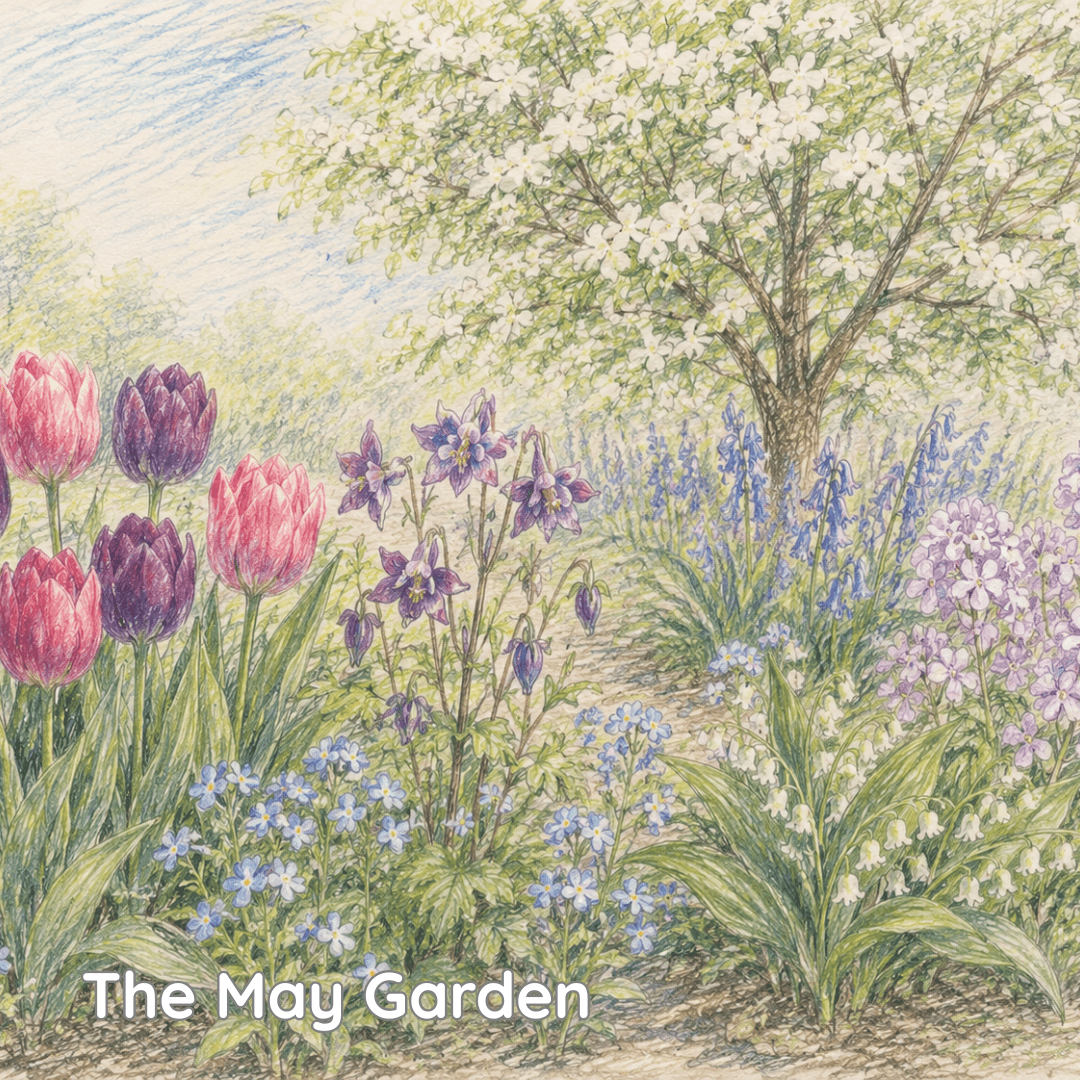
A month of quiet abundance and unfolding stories
There is a moment in May—often in the early morning, when the light is still soft—when the garden feels as though it has taken a breath and settled into itself.
April’s urgency has passed. The rush of first growth, the tentative greening, the uncertainty of frost—all behind us now. In their place comes something steadier. Borders begin to fill, colours deepen, and the garden starts to feel less like a collection of plants and more like a place with its own rhythm and voice.
To walk through it at this time of year is to notice not just what is in bloom, but how each plant seems to carry a story—of history, of meaning, of quiet return.
The tulips are often the first to catch the eye.
They stand with a certain confidence now, their forms no longer tightly held but open—petals curved wide to the sky. Tulipa, as they are known botanically, have travelled far to reach this moment in the garden. Once coveted to the point of obsession, their beauty sparked a frenzy centuries ago, when a single bulb might be traded for the price of a house. Today, they feel both extravagant and familiar.
They speak, perhaps, of something simple: that beauty need not last long to be deeply felt.
Beneath them, and often half-hidden, lily of the valley begins its quiet work.
Convallaria majalis is not a plant that demands attention. Its small white bells hang modestly, releasing a fragrance that seems almost too delicate for the scale of the garden. And yet, it lingers—soft, persistent.
It has long been associated with the return of happiness, gathered in May as a symbol of renewal. There is something reassuring in that idea. That even the smallest, most understated things can carry meaning enough to endure.
As the eye lifts, the alliums begin to rise.
Tall, architectural, and improbably precise, their globe-shaped flowers—clusters of countless tiny blooms—hover above the border like quiet punctuation marks. Members of the Allium family, they share their lineage with onions and garlic, yet here they are transformed into something almost sculptural.
There is patience in their growth. A reminder, perhaps, that what appears simple is often the result of time and careful unfolding.
Nearby, aquilegia weave themselves gently through the planting.
Aquilegia vulgaris, sometimes called columbine, has a softness to it—a tendency to lean, to drift slightly off centre, as though guided more by breeze than by structure. It is a plant that belongs as much to memory as to the present, often found in older gardens where it has quietly settled and returned, year after year.
There is a sense of continuity in it. A feeling that the garden does not begin or end with us.
And then, almost suddenly, the peonies begin to open.
At first, they are all promise—tight buds, rounded and waiting. But given a few warm days, they unfurl into something altogether more extravagant. Paeonia lactiflora carries with it centuries of admiration, a plant long associated with prosperity and honour.
Yet their beauty is fleeting. Petals fall as quickly as they open.
It is this briefness, perhaps, that makes them so compelling.
Threading through the borders, the forget-me-nots hold their ground.
Myosotis sylvatica—small, bright, and unassuming—form soft drifts of blue that seem to gather light rather than reflect it. They ask very little of the gardener, and yet offer something enduring.
Their name alone carries a weight of feeling. A quiet insistence on remembrance.
Beyond the garden’s edges, or sometimes woven into its wilder corners, hawthorn comes into bloom.
Crataegus monogyna, the May tree, marks the turning point of the season. Its blossom—frothy, white, and abundant—has long been gathered for May Day celebrations, though never brought indoors, where folklore warns it brings ill fortune.
Stand near it, and there is a particular scent—earthy, unmistakable.
It is the smell of the countryside in May.
In shaded spaces, where the garden leans towards woodland, bluebells settle into their own quiet display.
Hyacinthoides non-scripta are not showy in the way of tulips or peonies. Instead, they create atmosphere—drifts of soft violet-blue that seem to belong to another time.
They are often a sign of ancient ground, places where the soil has remained undisturbed for generations.
To walk among them is to feel, briefly, part of something much older.
Closer to the path, the irises begin to catch the light.
Named for the messenger goddess who travelled on rainbows, Iris germanica carries a certain elegance. Each flower feels intricately made—petals marked, folded, and edged with care.
They stand as a reminder that the garden is not just a place of growth, but of detail.
And as evening draws in, there is one final presence worth noticing.
Sweet rocket, Hesperis matronalis, does not announce itself in the brightness of day. It waits. But as the light fades, its scent begins to drift—soft, almost imperceptible at first, then quietly filling the air.
It is a plant that rewards attention, but only if you linger.
A Garden to Be Noticed
May does not overwhelm. It invites.
It asks that we slow down, that we look a little closer, that we notice not just the bold colours, but the spaces between them—the scent carried on the air, the movement of stems, the quiet return of plants that have been here long before us.
In this way, the garden becomes more than a collection of flowers.
It becomes a story—one that unfolds, gently, year after year.
Further Reading: How to Refurbish Your Garden to Add Value to Your Home, How to create a thriving garden on a new build plot, Sustainable Hardscaping: Build a Beautiful, Eco-Friendly Garden, Climate-Resilient Planting: Future-Proofing Your Garden, Transform Your Garden into a Butterfly Haven, Ten Plants that butterflies love
Inspiration: Follow Us on Instagram, Threads, BlueSky, Twitter, TikTok and Pinterest.