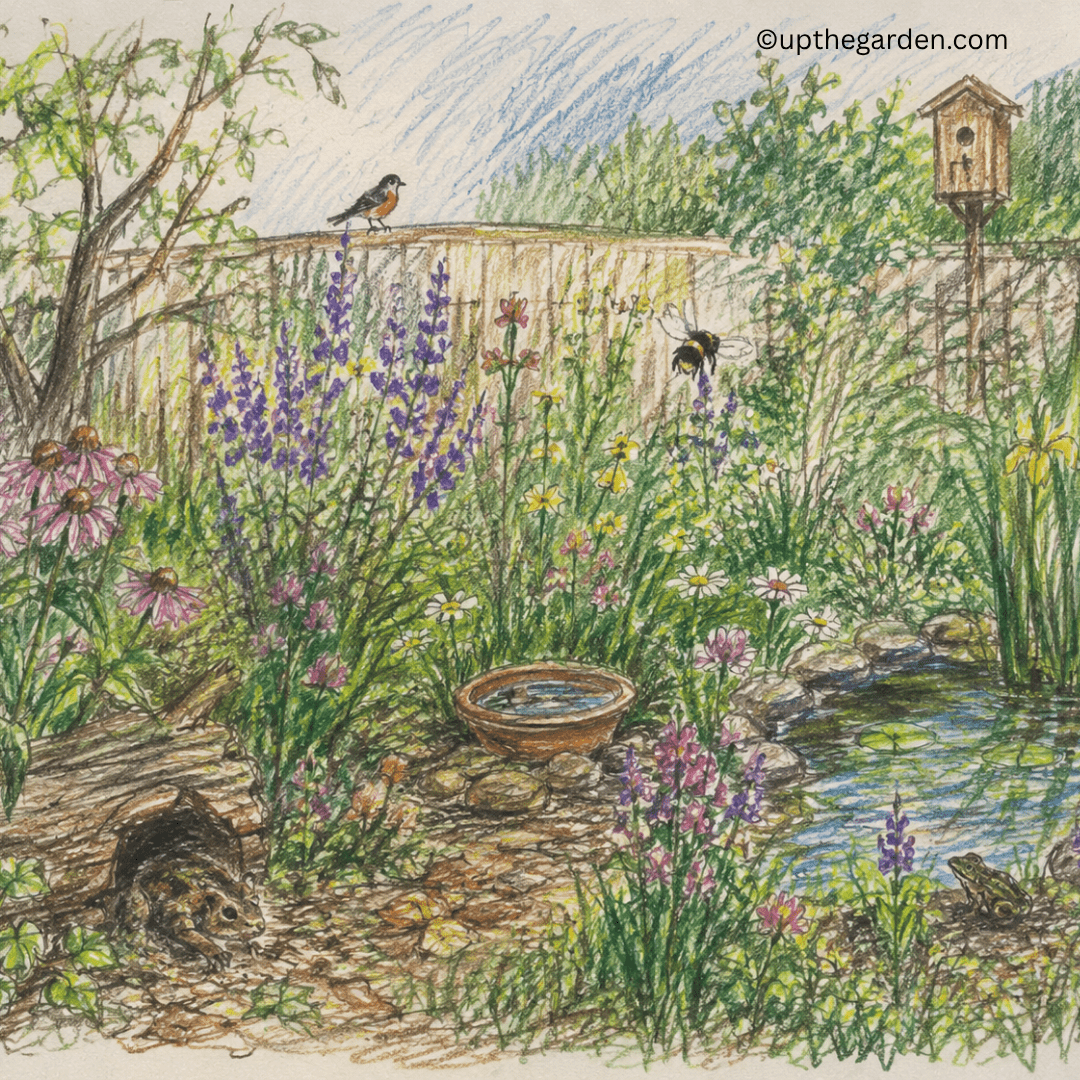
There is a certain kind of silence that settles over a tidy garden.
The clipped lawn stands in perfect stripes. The flower beds are sharply edged. Fallen leaves are swept away before they have the chance to soften into the soil. There are no nettles in the corners, no seed heads left standing through winter, no hollow stems for insects to disappear into. It is neat. Controlled. Ordered.
And often, strangely quiet.
No hum of bees drifting lazily between flowers. No rustle in the hedge. No blackbird turning leaves in search of worms. No frogs hidden in cool shade beside water.
For almost a century, Sir David Attenborough has invited us to look more closely at the living world around us. Across oceans, forests and grasslands, his voice has reminded generations that nature is not something distant or separate from us. It begins at our own doorstep. In the cracks of pavements. In roadside verges. In tiny gardens behind terraced houses. In the overlooked spaces we choose either to tame or to share.
As David Attenborough reaches his 100th year, perhaps one of the most meaningful ways to honour that legacy is not through grand gestures, but through small acts of welcome. A patch left wild. A tree planted for future generations. A garden allowed to breathe again.
Because your garden matters more than you think.
The Quiet Disappearance of Wildlife
Many of us grew up with summers alive with movement. Bees thick among lavender. Butterflies dancing over long grass. Sparrows gathering noisily in hedges at dusk. Even the ordinary seemed abundant.
Today, much of that richness has faded.
Across Britain, pollinating insects have declined dramatically. Hedgehogs struggle to move through fenced and paved landscapes. Birds once common in gardens are now increasingly absent. The spaces between wild places have become harder for nature to cross.
Yet gardens — collectively — form one of the largest wildlife habitats in the country.
Taken together, the gardens of Britain cover more land than all our national nature reserves combined. Every pond, hedge, window box and flowering border becomes part of a larger patchwork. A corridor. A resting place. A source of food.
This is why even the smallest garden matters.
A few square metres of flowering plants can feed bees travelling through urban streets. A pile of decaying wood can shelter beetles and fungi. A shallow bowl of water can save exhausted pollinators during periods of heat.
Wildlife does not ask for perfection. It asks only for possibility.
Letting Nature Back In
For decades, gardening was often treated as a battle against disorder.
Weeds were enemies. Fallen leaves were waste. Moss was a nuisance. Insects were problems to eliminate. The ideal garden became something controlled to within an inch of its life.
But nature has never thrived under constant correction.
To garden with wildlife in mind is to loosen our grip slightly. To understand that beauty can exist in movement, decay and unpredictability. A foxglove leaning unexpectedly through a border. Seed heads catching frost in winter light. Long grass shifting in the breeze.
A wild patch does not mean neglect. It means intention of a different kind.
Perhaps it begins with allowing part of the lawn to grow longer through spring and summer. Daisies emerge. Clover flowers. Bees arrive. Suddenly the garden sounds alive again.
Perhaps it means resisting the urge to cut everything back in autumn. Hollow stems become winter shelter for insects. Seed heads feed birds when colder months arrive. Fallen leaves enrich the soil naturally as they break down.
The modern garden has become increasingly tidy. But life often flourishes in the untidy edges.
Plant for Pollinators, and They Will Come
If there is one simple act that transforms a garden, it is planting for pollinators.
Bees, butterflies, hoverflies and moths depend on nectar-rich flowers throughout the seasons. Yet many modern gardens contain little for them to feed on, especially those dominated by paving, artificial grass or highly ornamental plants bred without nectar.
A wildlife-friendly garden hums with succession — something flowering from early spring until late autumn.
Crocuses and snowdrops offer early food for emerging bees when little else is available. Lavender, verbena, foxgloves and catmint carry gardens through summer. Ivy flowers become vital late-season nourishment as autumn approaches.
Native plants are especially valuable because wildlife has evolved alongside them over thousands of years. Hawthorn, wild marjoram, field scabious and knapweed support an extraordinary diversity of insects.
And with insects come birds.
A single brood of blue tits may require thousands of caterpillars before fledging. What appears to be a messy, insect-filled garden is, in truth, part of an intricate food web supporting life at every level.
This is the extraordinary thing about gardening for wildlife: the more life you welcome, the more life arrives.
Water: The Simplest Gift
Even the smallest source of water can transform a garden.
In hot weather, birds queue beside shallow dishes. Bees gather cautiously at the edges. Frogs appear almost mysteriously, as though summoned from nowhere. Dragonflies arrive if ponds are allowed to establish naturally.
A wildlife pond need not be large or formal. A half barrel, an old sink or a shallow container sunk into the ground can become a lifeline.
What matters most is accessibility. Gentle edges. Stones for insects to land on. Clean water replenished regularly during dry spells.
Water creates movement and connection in a garden. It draws wildlife into view and reminds us how dependent all living things are on the simplest resources.
In many ways, wildlife gardening begins not with planting, but with paying attention.
Gardening Without Chemicals
There is a growing understanding that many chemicals once routinely used in gardens come at a hidden cost.
Pesticides rarely distinguish between pests and pollinators. Herbicides remove plants that insects rely upon. Artificial fertilisers can weaken soil ecosystems over time.
Healthy gardens are living systems, rich with fungi, microbes, worms and insects working beneath the surface. The more diverse the ecosystem, the more resilient it becomes.
When aphids appear, ladybirds often follow. Birds feed young on caterpillars. Frogs and hedgehogs help manage slugs naturally. Problems become part of a wider balance rather than something to eradicate instantly.
Nature has spent millions of years refining relationships between species. Wildlife-friendly gardening trusts those relationships more deeply.
It asks us to step away from control and toward coexistence.
Plant Trees for the Future
There is something profoundly hopeful about planting a tree.
A tree is an act of faith in years we may never fully see ourselves. It is shade for future summers. Shelter for birds not yet born. Blossom for pollinators decades from now.
Even small gardens can hold trees carefully chosen for their space. Crab apple, rowan, silver birch and hawthorn all support wildlife beautifully while bringing seasonal change and structure.
Trees cool cities, store carbon, filter pollution and soften noise. But beyond all this, they reconnect us emotionally with the passing of time.
David Attenborough has spent a lifetime showing us ancient forests and fragile ecosystems shaped over centuries. Planting a tree reminds us that we too are part of a longer story.
Gardens are not simply possessions to manage. They are places we borrow briefly before passing on.
Stop Tidying Everything
Perhaps the hardest lesson for modern gardeners is learning when to leave things alone.
A decaying log may appear lifeless, yet inside it entire worlds are unfolding. Beetles tunnel through softened wood. Fungi spread delicate threads beneath bark. Mosses gather moisture. Small creatures shelter through winter cold.
Dead wood is not dead space.
Neither are leaf piles, seed heads or fading stems. They are habitat.
In nature, nothing is wasted. Everything feeds something else.
The impulse to clear away every sign of decay often removes the very conditions wildlife depends upon. A perfectly tidy garden can become an ecologically empty one.
This does not mean abandoning beauty. Rather, it asks us to redefine it.
Beauty can be found in balance. In birdsong. In bees weaving through flowers. In the first frogspawn of spring. In knowing the garden is alive beyond our own enjoyment of it.
Working With Nature, Not Against It
The most inspiring gardens are rarely the most controlled.
They are the ones that feel connected to the landscape around them. Gardens where swallows skim overhead. Where bees drift between herbs. Where hedges shelter nesting birds and long grass moves like water in evening light.
Gardening with nature is ultimately an act of humility. It recognises that we are participants rather than masters.
And perhaps that is why wildlife gardening feels increasingly important now.
In a world facing climate change, biodiversity loss and growing disconnection from the natural world, our gardens become more than decoration. They become places of restoration — for wildlife and for ourselves.
A wild patch can change the atmosphere of a garden completely. It slows us down. Encourages observation. Reminds us that life is constantly unfolding in ways we barely notice when rushing past.
Children crouch to watch insects. Adults begin recognising birdsong again. Seasonal rhythms return quietly to daily life.
The garden becomes less about display and more about relationship.
Your Garden Matters
It is easy to feel that environmental problems are too large, too distant, too overwhelming for individual action to matter.
But nature works through accumulation.
One flower visited by a bee. One pond supporting frogs. One tree absorbing carbon. One untidy corner sheltering overwintering insects.
Then another.
And another.
Across towns, villages and cities, small acts join together into something far greater than they first appear.
David Attenborough has spent nearly a century encouraging us to notice the wonder of the natural world. Perhaps the greatest tribute we can offer in his 100th year is not admiration alone, but participation.
A garden can be more than a space to control.
It can become a sanctuary. A refuge. A promise to the future.
So leave a patch wild.
Plant flowers for pollinators.
Put out water in dry weather.
Plant a tree whose shade you may never sit beneath.
Allow leaves to gather. Let things decay. Resist the urge to tidy every corner.
And listen carefully as life begins to return.
Because your garden matters. More than ever.
Further Reading: Creating a Butterfly Garden: A Quiet Invitation to Nature, Ten Plants that butterflies love, Sustainable Hardscaping: Build a Beautiful, Eco-Friendly Garden, Why Bees Are Essential to Our Gardens, Top 10 Garden Birds in the UK (and How to Spot Them), Helping Wildlife This Winter, How to Create and Maintain a Garden Pond, Transform Your Allotment into a Biodiversity Haven
Inspiration: Follow Us on Instagram, Threads, BlueSky, Twitter, TikTok and Pinterest.