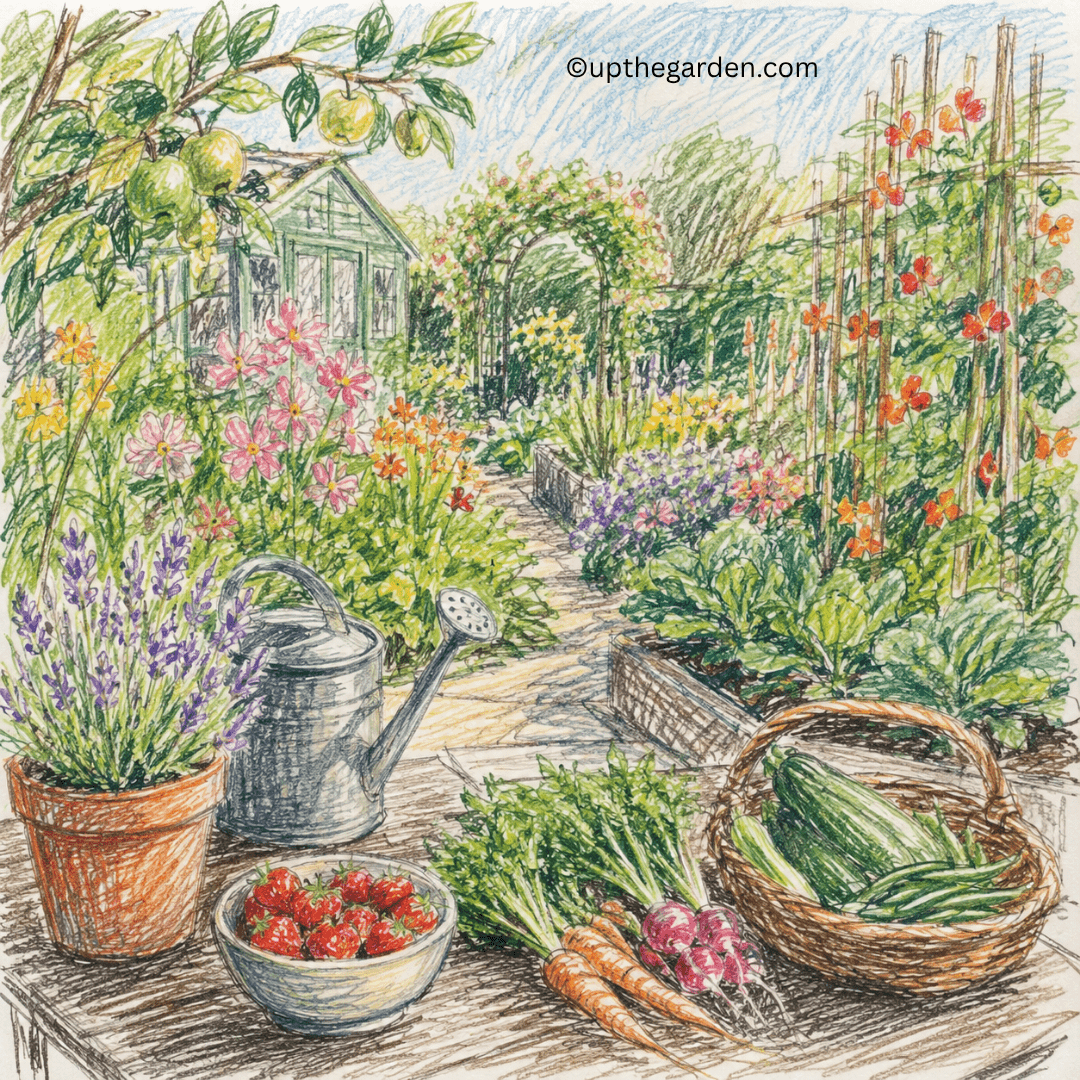
There comes a moment each year when the garden seems to take a deep breath and simply flourish.
July is that moment.
The careful planning of winter, the hopeful sowing of spring and the patient tending of early summer suddenly come together in an extraordinary display of colour, scent and abundance. Borders swell beyond their edges, roses reach their glorious peak, vegetables seem to grow almost while you’re watching, and every corner hums quietly with life.
This is not a month for rushing.
The July garden asks something rather different of us. It invites us to slow our pace, wander without purpose and notice the countless small details that might otherwise pass us by. A bee disappearing deep into a foxglove. The delicate lacework of a spider’s web sparkling with morning dew. A blackbird carrying worms across the lawn. The scent of sweet peas drifting gently on the warm afternoon air.
Gardens have always rewarded those who linger.
Early morning is perhaps the finest time to step outside.
Before the day gathers its warmth, leaves are still cool beneath your fingertips and birds fill the air with song. The low sun catches the silvery foliage of lavender, ornamental grasses shimmer with dew and every flower seems freshly opened to greet the day.
This is when roses are at their most enchanting.
For centuries they have been celebrated not only for their beauty but also their extraordinary fragrance. Ancient Persians distilled rose water long before it appeared in European gardens, while medieval monasteries grew roses for medicines, perfumes and food.
Even today, few scents evoke an English summer quite so completely.
Removing faded blooms now quietly encourages many varieties to flower again. It is one of those gentle tasks that feels less like work and more like caring for an old friend.
Nearby, the sweet peas continue their own performance.
The more flowers you gather, the more they bloom, filling the house with perfume that no bottle has ever quite managed to recreate. There is quiet satisfaction in cutting a handful each morning, knowing tomorrow there will almost certainly be more.
As the writer Beverley Nichols once observed:
“To plant a garden is to believe in tomorrow.”
By July, tomorrow has arrived.
The herbaceous borders have found their rhythm.
Delphiniums stand proudly above neighbouring perennials, salvias dance with bees, achillea catches the sunlight, while echinacea and rudbeckia begin their long summer display. Every border changes almost daily, colours weaving together in combinations that no designer could completely predict.
One of gardening’s greatest lessons is learning when not to interfere.
Leave a few flowers to mature into seed heads and they become every bit as beautiful as the blooms themselves. Poppies transform into elegant green sculptures. Alliums dry into delicate globes that catch the evening light, while teasels quietly prepare a feast for goldfinches later in the year.
A garden need not always be flowering to be beautiful.
Sometimes structure tells the richer story.
There is another orchestra playing too.
Listen for a moment.
The steady hum around lavender belongs to bumblebees gathering nectar. Hoverflies drift effortlessly between flowers, quietly pollinating as they go. Butterflies settle on verbena and buddleia, while dragonflies patrol nearby ponds with astonishing precision.
Even the smallest insect hotel is likely to be busy now.
July reminds us that a successful garden is measured not simply by the plants we grow, but by the wildlife we welcome.
Leave a shallow dish of water for bees.
Allow a little patch of grass to flower.
Resist the temptation to tidy every corner.
Nature often asks for less intervention than we imagine.
Meanwhile, the kitchen garden begins offering generous rewards.
Courgettes seem to appear overnight, broad beans swell in their pods and tomatoes slowly deepen from green to glowing red. Herbs become wonderfully abundant. Basil waits beside ripening tomatoes, parsley spills over raised beds, mint threatens to take over entirely and thyme perfumes every warm pathway.
Freshly lifted new potatoes remain one of July’s greatest pleasures.
There is little ceremony required. Simply boil them gently before tossing with butter, chopped parsley and a pinch of sea salt.
Sometimes the finest meals are also the simplest.
Nearby, strawberries continue producing their sweetest fruit, while raspberries hide beneath leafy canes waiting to surprise anyone willing to look closely enough.
July is not simply beautiful.
It is delicious.
As afternoon warmth settles across the garden, scents become richer.
Lavender perfumes the borders.
Climbing roses release their fragrance.
Jasmine begins to fill the evening air.
It is perhaps the perfect moment to pause with a cup of tea beneath a favourite tree and simply watch.
Children search for butterflies.
Bees continue their patient work.
Swallows skim low across the lawn.
A robin appears, hopeful that today’s gardening might uncover another worm.
The garden continues perfectly well without us for a little while.
By evening, long shadows stretch across the borders and the colours soften once again.
This is when white flowers begin to glow.
Nicotiana, cosmos and hydrangeas seem almost luminous beneath the fading light. The warmth of the day lingers in brick walls and greenhouse glass, while blackbirds offer one final song before dusk settles quietly over the garden.
There is a deep contentment in July evenings.
Not because every weed has been removed or every border looks perfect, but because gardens are living places rather than finished projects.
They are always becoming.
Always changing.
Always offering something new to notice tomorrow.
Perhaps that is why July is loved by so many gardeners.
It reminds us that gardening has never really been about flowers alone.
It is about patience rewarded.
About sharing strawberries still warm from the sun.
About muddy hands, buzzing bees, birdsong drifting through open windows and quiet moments spent watching butterflies dance across the borders.
The work of spring has become the joy of summer.
And for a few precious weeks, the garden gives back far more than it asks.
Recipe: Summer Garden Herb & Courgette Tart
A light lunch celebrating some of July’s finest harvests.
Ingredients
- 1 sheet ready-rolled puff pastry
- 2 medium courgettes, thinly sliced
- 150g soft goat’s cheese
- 2 tbsp crème fraîche
- A handful of fresh basil
- A handful of chopped parsley
- Fresh thyme leaves
- Olive oil
- Sea salt and black pepper
- Optional: a drizzle of local honey
Method
- Heat the oven to 200°C (180°C fan).
- Score a 2cm border around the pastry and prick the centre with a fork.
- Mix the goat’s cheese with the crème fraîche and spread over the pastry.
- Arrange the courgette slices on top, brushing lightly with olive oil.
- Scatter with thyme, season well and bake for 25–30 minutes until golden.
- Finish with fresh basil, parsley and, if you like, a drizzle of honey.
Serve warm with freshly picked salad leaves and buttered new potatoes.
A Gentle Reminder
July is also the month to water wisely. A thorough soak in the cool of the morning or evening is far kinder to plants than frequent light watering. Harvest little and often, keep picking flowers to encourage more blooms, and don’t be too quick to tidy every fading stem. Seed heads, long grass and a few untamed corners provide food and shelter for the wildlife that makes every summer garden feel truly alive.
Further Reading: How and When to Thin your Fruit Trees, How to Grow your Own Fruit, Guide to Store your Fruit Harvest,
Inspiration: Follow Us on Instagram, Threads, BlueSky, Twitter, TikTok and Pinterest.