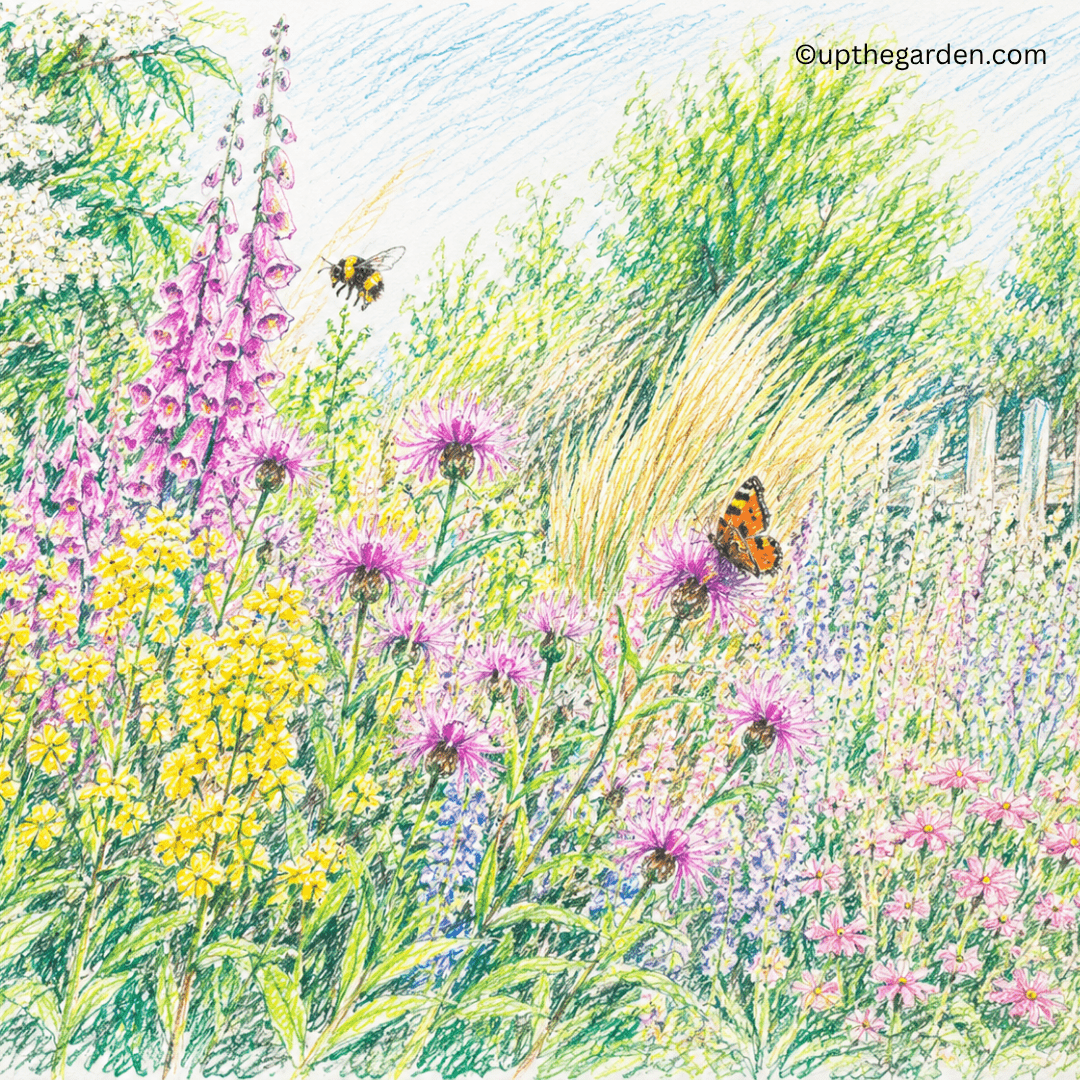
Stand quietly in a garden on a warm summer morning and, at first glance, it can appear peaceful, even still.
A blackbird turns over leaves beneath a hedge. Bees drift lazily between flowers. Sunlight catches the edges of newly unfurled leaves.
Yet beneath this apparent calm, an extraordinary world is at work.
Tiny hunters patrol stems and borders. Pollinators move methodically from bloom to bloom. Beetles emerge under cover of darkness to tackle pests long before most gardeners have risen for the day.
Many of us have been conditioned to think of insects as a problem to solve. A nibbled leaf, an aphid-covered rose or a damaged vegetable crop can quickly send us searching for remedies.
But nature rarely operates in isolation.
For every pest, there is often a predator.
For every imbalance, a network of species quietly working to restore harmony.
The most successful gardens are not those free of insects. They are those rich in life.
Learning to See a Garden Differently
There comes a moment in many gardeners’ journeys when their perspective begins to change.
Instead of asking, “How do I get rid of these insects?” they begin asking, “Why are they here?”
It is a subtle shift, but an important one.
A healthy garden is not a perfectly controlled environment. It is an ecosystem.
Just as woodlands, meadows and coastlines thrive through diversity, gardens flourish when a variety of species can find food, shelter and space to complete their life cycles.
Once we begin to look more closely, we discover that some of the most valuable garden allies are creatures many people barely notice.
The Delicate Lacewing
Lacewings are easy to overlook.
With their translucent wings and gentle appearance, they seem almost fragile.
Yet their larvae are among the most effective predators in the garden.
Often nicknamed “aphid lions”, these voracious hunters feed on aphids, caterpillars and whiteflies, helping to keep populations in balance.
Planting nectar-rich flowers such as cosmos, sunflowers and sweet alyssum can encourage adult lacewings to visit and remain in your garden.
Their presence is a reminder that appearances can be deceptive. Some of nature’s most effective problem-solvers arrive dressed in the gentlest of forms.
The Night Shift: Ground Beetles
While many gardeners sleep, another workforce begins its shift.
Ground beetles emerge under cover of darkness, hunting slugs, caterpillars and cutworms among the borders.
They are one of the reasons why a garden left slightly untidy can often be healthier than one maintained with military precision.
Leaf litter, mulch and ground-cover plants provide shelter and breeding sites for these valuable predators.
A perfectly tidy garden may satisfy our sense of order, but nature often prefers a little messiness.
Ladybirds and Their Endless Appetite
Few garden insects enjoy a more favourable reputation than the ladybird.
Children delight in spotting them, and gardeners celebrate their arrival.
For good reason.
Both adults and larvae consume large numbers of aphids, helping to protect ornamental plants, fruit bushes and vegetables.
What many people do not realise is that ladybird larvae look entirely different from their familiar spotted parents. Dark, elongated and somewhat prehistoric in appearance, they are often mistaken for pests.
Learning to recognise every stage of an insect’s life cycle is one of the pleasures of wildlife gardening.
The more we understand, the more fascinating our gardens become.
Hoverflies: Masters of Disguise
At first glance, a hoverfly may be mistaken for a wasp.
Its yellow and black markings are a clever evolutionary strategy, discouraging predators despite the fact that hoverflies cannot sting.
These remarkable insects perform two valuable roles.
Adults are excellent pollinators, visiting countless flowers throughout the season. Their larvae, meanwhile, feed on aphids and other soft-bodied pests.
Planting marigolds, lavender and daisies can help attract them.
The reward is not simply healthier plants, but a garden humming with life.
The Unseen Specialists
Some of the garden’s most effective allies are rarely noticed at all.
Parasitic wasps, for example, sound alarming but are harmless to humans. Many are tiny—sometimes smaller than a grain of rice.
Their role is extraordinary.
They help control populations of caterpillars, whiteflies and aphids by laying eggs within host insects, naturally limiting outbreaks before they become problematic.
Similarly, tachinid flies play a crucial role in regulating pest populations, targeting caterpillars, beetles and other garden nuisances.
These species remind us that nature’s solutions are often more sophisticated than anything we might design ourselves.
The Garden’s Patient Hunters
Among the most captivating predators are praying mantises, assassin bugs and spiders.
Each employs a different strategy.
Mantises wait motionless before striking with astonishing speed.
Assassin bugs actively stalk their prey.
Spiders weave intricate traps or hunt directly, reducing populations of flies, mosquitoes and moths.
Though some gardeners remain wary of these creatures, they perform an essential service.
Without predators, ecosystems quickly become unbalanced.
Predation may seem harsh, but it is one of the mechanisms through which nature maintains health and diversity.
Gardening for Wildlife, Not Against It
Perhaps the most important lesson is that attracting beneficial insects is less about introducing specific species and more about creating the right conditions.
A garden rich in flowers provides nectar and pollen.
Shrubs and hedges offer shelter.
Leaf litter creates habitat.
Long grass supports overwintering insects.
Native plants often provide food sources that local wildlife has evolved alongside for centuries.
The result is not merely a more resilient garden, but a more interesting one.
A garden becomes a place of discovery rather than control.
Finding Wonder in the Small Things
There is a tendency to celebrate wildlife in its larger forms.
The barn owl gliding at dusk.
The deer stepping through woodland.
The kingfisher flashing electric blue across a river.
Yet some of the most extraordinary stories unfold at a much smaller scale.
A lacewing larva hunting aphids on a rose stem.
A hoverfly balancing delicately on a daisy.
A ground beetle beginning its nightly patrol.
These creatures may be small, but their contribution is immense.
Together they form a hidden workforce that pollinates our flowers, protects our crops and supports the delicate balance upon which healthy gardens depend.
The next time you pause among the borders, take a closer look.
What first appears to be a simple flower bed may reveal itself as a bustling community of gardeners, hunters, pollinators and protectors.
And perhaps that is one of the greatest joys of gardening.
Not simply growing plants, but learning to share a space with the countless small lives that help them thrive.
Further Reading: How to Make Your Own Liquid Fertiliser from Comfrey, How to Start Composting at Home, How to Discover Your Soil Type (And Why It Matters), Creating a Butterfly Garden: A Quiet Invitation to Nature
Inspiration: Follow Us on Instagram, Threads, BlueSky, Twitter, TikTok and Pinterest.