The June Garden: Roses, Foxgloves and the Romance of Early Summer

June arrives quietly, and then all at once. One warm morning the garden seems to have changed entirely. Roses unfurl overnight, borders swell with colour, and every pathway is edged with soft growth that only days before seemed hesitant. Early summer has a generosity to it that no other season quite matches.

This is the month when the garden feels deeply alive. The air carries the scent of flowers long into the evening, bees move lazily between blooms, and every corner offers something new to notice. June does not demand attention in dramatic ways. Instead, it rewards those willing to wander slowly, pausing among the borders as sunlight shifts across petals and leaves.

Roses in Full Glory

No flower defines the June garden quite like the rose. Climbing roses scramble over arches and old brick walls, while shrub roses fill borders with layers of soft pink, creamy white and deep crimson. Their fragrance drifts across the garden in waves, especially after rain or during the warmth of late afternoon.

There is something wonderfully nostalgic about roses at this time of year. Petals scatter onto gravel paths, buds continue to open day after day, and even the simplest bloom feels extravagant against the fresh green of early summer foliage.

Old-fashioned varieties bring a romantic softness to borders, while repeat-flowering roses promise colour well into the season ahead. Planted among lavender, catmint and salvia, they create the relaxed abundance that defines a classic June garden.

Lavender itself begins to wake properly in June, its silver foliage catching sunlight while the first purple flowers attract bees in their hundreds. Along sunny paths, the scent rises with the warmth of the day, creating those unmistakable moments that linger in memory long after summer has passed.

Foxgloves, Delphiniums and Cottage Garden Colour

June belongs to tall flowers. Foxgloves rise elegantly through borders, their spires crowded with bell-shaped blooms in shades of blush pink, cream and rich magenta. Bees disappear deep inside each flower before emerging dusted in pollen.

Nearby, delphiniums stand proudly in cool shades of blue and violet, bringing height and drama to cottage garden planting schemes. Lupins push upwards too, adding structure among softer plants, while peonies hold enormous blooms that seem almost too heavy for their stems.

Hardy geraniums spill generously between larger plants, knitting borders together with clouds of purple, blue and white flowers. Their looseness softens edges beautifully, allowing the garden to feel natural rather than overly arranged.

Then there are the poppies. Fragile, paper-thin petals catch the light in ways few flowers can manage. Some glow in fiery orange and scarlet, while others appear almost translucent in softer shades of pink and white. Even the slightest breeze brings movement to the border.

Sweet Peas and Evening Scent

By mid-June, sweet peas begin climbing in earnest, wrapping themselves around supports and filling the air with perfume. Few flowers reward attention quite so generously. The more they are picked, the more they flower, producing endless stems for small jars indoors.

Their scent feels inseparable from early summer evenings. Soft, sweet and unmistakably nostalgic, it drifts through the garden as the light begins to fade. Mixed colours tumbling together on canes bring a relaxed beauty that suits June perfectly.

Nearby, honeysuckle begins to flower too, threading itself through hedges and fences with delicate trumpet-shaped blooms. In the evening its fragrance becomes stronger, drawing moths and pollinators into the garden as dusk settles.

Irises, Alliums and Layers of Colour

June gardens are at their most beautiful when planting is layered. Earlier spring flowers begin to fade just as summer favourites take their place, creating depth and richness across borders.

Tall alliums still hover above planting schemes like floating purple spheres, while irises continue to provide flashes of jewel-like colour. Their petals appear almost silk-like in sunlight, especially after rain showers leave droplets resting along each edge.

Aquilegias seed themselves freely at this time of year, popping up unexpectedly between paving stones and borders in delicate shades of mauve, blue and deep burgundy. There is joy in allowing some flowers to wander where they please. The garden feels softer and more connected to the landscape around it.

Containers Overflow with Summer Colour

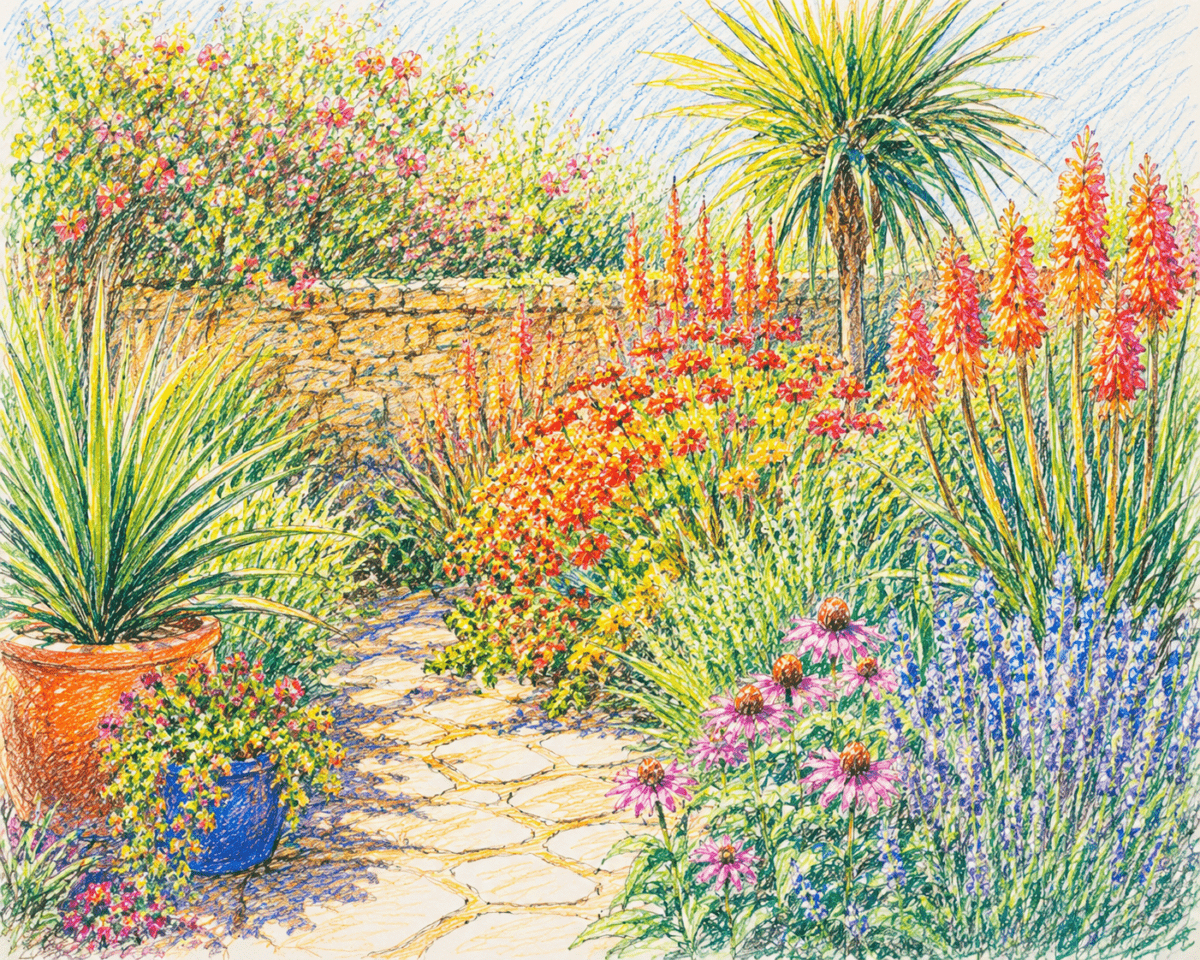
Pots and containers become increasingly important in June, especially near doorways and seating areas where flowers can be enjoyed up close. Terracotta pots spilling with trailing lobelia, scented pelargoniums and delicate bacopa bring colour to patios and courtyards.

Cosmos planted earlier in the season begin to strengthen now, their feathery foliage adding lightness among fuller summer planting. By late June, the first flowers appear, dancing gently above borders and attracting pollinators throughout the day.

Herbs deserve attention too. Chives flower in soft purple pom-poms, thyme spills across warm stone edges and mint releases fragrance whenever brushed past. Even the kitchen garden feels ornamental in June.

The Wildlife Among the Flowers

The June garden is never still. Bumblebees bury themselves inside foxgloves, butterflies drift across sunny borders and birds move constantly through shrubs searching for insects and seed.

Planting with pollinators in mind transforms the garden into something richer and more vibrant. Lavender, verbena bonariensis, scabious and salvias all provide valuable nectar while creating softness and movement within borders.

As evening approaches, the garden changes character once again. Moths appear around honeysuckle and jasmine, while the scent of roses lingers in cooling air. Twilight in June carries a calmness unlike any other month.

Gentle Tasks for the June Garden

Although June feels abundant, it is still a month for careful tending. Deadheading roses encourages repeat flowering, while tying in sweet peas and climbing plants keeps growth secure through summer winds.

Regular watering becomes increasingly important during dry weather, especially for containers and newly planted borders. Deep watering in the early morning or evening helps plants establish stronger roots and cope better during warmer spells.

It is also the perfect time to cut flowers for indoors. Fresh roses, sweet peas and peonies gathered from the garden bring the beauty of June into every room.

The Beauty of Early Summer

Perhaps the greatest joy of the June garden is the sense that everything is reaching towards fullness. Every day brings another flower into bloom, another fragrance carried on warm air, another reason to pause a little longer outdoors.

There is romance in the looseness of June planting — roses leaning into lavender, foxgloves rising unexpectedly among grasses, petals scattered after rain. Nothing feels rigid or controlled. Instead, the garden settles into a natural rhythm shaped by sunlight, showers and growth.

Long evenings stretch gently ahead, inviting slow walks through borders glowing in golden light. And somewhere among the roses, lavender and sweet peas, June quietly becomes the month gardeners remember most.

Further Reading: Growing Roses , Rose Replant Disease, History and Importance of the Rose, How to Grow Roses Successfully

For daily inspiration Follow Us on Instagram

Caring for Your Garden in Hot Weather: Helping Plants Through a Heatwave

There is something irresistible about a warm summer’s day in the garden.

The borders are alive with colour, bees drift lazily between flowers, and long evenings invite us outdoors long after the working day is done. Yet while we may welcome the sunshine, our gardens often experience it rather differently.

After several days of heat, even the healthiest plants can begin to look weary. Leaves droop. Flowers fade more quickly. Containers dry out at surprising speed. The greenhouse, once a place of growth and promise, can start to feel more like an oven.

The good news is that most plants are remarkably resilient when given the right care. The secret isn’t necessarily watering more, but watering wisely.

Understanding what heat does to plants

Plants lose moisture through their leaves throughout the day. During hot weather, this process speeds up dramatically.

To protect themselves, many plants temporarily wilt, particularly during the hottest part of the afternoon. This can look alarming, but it isn’t always a sign that a plant is dying.

Much like us seeking shade on a hot day, plants have their own ways of coping.

The important thing is to observe carefully before reaching for the watering can. A plant that looks exhausted at 3pm may have recovered completely by evening.

The biggest mistake gardeners make

When temperatures soar, it’s tempting to water whenever plants appear distressed.

Unfortunately, midday is often the worst possible time.

Water applied during the hottest part of the day evaporates quickly before it can reach the roots where it is needed most. In extreme conditions, rapid temperature changes can also place additional stress on already struggling plants.

Instead, water either:

  • Early in the morning before temperatures rise.
  • Later in the evening once the heat of the day has passed.

These cooler periods allow moisture to soak deeply into the soil, giving roots time to absorb it properly.

Think of it as offering a long, refreshing drink rather than a hurried splash.

Soak, don’t sprinkle

One of the most common sights during a heatwave is a gardener lightly spraying plants every day.

It feels helpful, but often achieves very little.

A brief sprinkle only wets the soil surface. The moisture disappears quickly, encouraging roots to remain close to the top where they are more vulnerable to drying out.

A deep soak is far more effective.

Water slowly and thoroughly so moisture penetrates well below the surface. This encourages roots to grow deeper into the soil where conditions remain cooler and more stable.

In hot weather, one deep watering is usually far more beneficial than several shallow ones.

Water the roots, not the leaves

When plants are struggling, our instinct is often to cool the foliage.

In reality, the roots are where attention should be focused.

Aim water directly at the base of the plant, allowing it to soak into the soil around the root zone.

Wet leaves provide only temporary relief and can sometimes encourage fungal problems when conditions change. The roots are the plant’s lifeline, and that’s where moisture will do the greatest good.

A slow trickle at ground level is often worth far more than a shower from above.

Containers need extra attention

Pots and containers can become particularly vulnerable during hot weather.

Unlike plants growing in open ground, they have only a limited volume of soil from which to draw moisture. Terracotta pots, while beautiful, can dry out especially quickly.

Check containers daily during prolonged heat.

Signs they need water include:

  • Soil pulling away from the edges of the pot.
  • Wilting that persists into the evening.
  • Containers feeling noticeably light when lifted.

Grouping pots together can help create a slightly cooler, more humid environment and reduce moisture loss.

Using mulch to lock in moisture

Nature rarely leaves bare soil exposed.

A layer of mulch helps mimic natural conditions by reducing evaporation and keeping the root zone cooler.

Suitable mulches include:

  • Garden compost
  • Well-rotted manure
  • Leaf mould
  • Bark chippings

Applied around plants, mulch acts like a protective blanket, helping precious moisture remain in the soil for longer.

During a heatwave, this simple step can make a remarkable difference.

Reviving heat-stressed greenhouse plants

Greenhouses present a particular challenge during periods of hot weather.

Even on a moderately warm day, temperatures inside can rise dramatically. During a heatwave, conditions may become severe enough to cause heat stress in tomatoes, cucumbers, peppers and other tender crops.

Signs of heat exhaustion include:

  • Wilting despite moist compost
  • Flower drop
  • Yellowing leaves
  • Scorched leaf edges
  • Slowed growth

If plants are suffering, resist the urge to flood them immediately.

Instead:

Increase ventilation

Open doors, vents and windows as early as possible each morning.

Encouraging airflow is one of the most effective ways to reduce excessive temperatures.

Create shade

Greenhouse shading paint, shade netting, or even temporary sheets positioned outside can help reduce the intensity of direct sunlight.

Water thoroughly at the roots

Give plants a deep watering during the cooler parts of the day, ensuring moisture reaches the entire root ball.

Damp down paths

Lightly wetting greenhouse paths and staging can help lower temperatures through evaporation without saturating plant roots.

Remove severely damaged foliage

If leaves have become scorched or crispy, remove them gradually. This allows plants to direct energy into healthy new growth.

Most importantly, be patient.

Plants often look worse before they recover. Given cooler conditions and consistent care, many will bounce back surprisingly well.

Accepting a little imperfection

One of the quiet lessons gardening teaches is that not every leaf needs to be perfect.

During prolonged hot weather, some flowers may fade sooner. A few leaves may scorch. Growth may temporarily slow.

This is part of the natural rhythm of the season.

The aim isn’t to create a flawless garden throughout every weather event. It is to help plants remain healthy enough to continue growing when conditions improve.

Working with the weather, not against it

The most successful gardeners rarely fight nature. Instead, they learn to observe it.

They notice which parts of the garden stay cool longest. They water before the day begins. They protect soil with mulch and recognise the difference between temporary wilting and genuine distress.

A heatwave can be challenging, but it can also teach us to garden more thoughtfully.

And as evening arrives, temperatures soften, and the first shadows stretch across the borders, there is a certain satisfaction in knowing that a few simple actions have helped your garden weather another hot summer’s day.

After all, gardening has never been about controlling nature. It has always been about working alongside it 💚

Further Reading: How to Help your Garden Survive when there is a Hosepipe Ban, The Art of Ollas, How to Refurbish Your Garden to Add Value to Your HomeHow to create a thriving garden on a new build plotSustainable Hardscaping: Build a Beautiful, Eco-Friendly GardenClimate-Resilient Planting: Future-Proofing Your GardenTransform Your Garden into a Butterfly HavenTen Plants that butterflies love

Inspiration: Follow Us on InstagramThreads, BlueSkyTwitterTikTok and Pinterest.
The Chelsea Chop: Keep Summer Flowering

There is a moment in every gardener’s year when courage is required.

The borders are filling out. Fresh green stems are stretching upwards. Buds are forming. Everything appears to be thriving. And then, just as the garden begins to look promising, experienced gardeners reach for their secateurs and start cutting healthy plants back.

To the uninitiated, it looks completely wrong.

Why would anyone deliberately cut down a flourishing perennial just as it is preparing to flower?

Yet this seemingly brutal act is one of the most effective techniques in ornamental gardening. Known as the Chelsea Chop, it can transform borders, prevent plants from flopping, encourage stronger growth, and extend flowering well into late summer and autumn.

It is one of those gardening traditions that feels almost magical. A simple intervention lasting only a few minutes can reward you with weeks of additional colour.

What Is the Chelsea Chop?

The Chelsea Chop is a pruning technique used on certain herbaceous perennials during late May, around the time of the famous RHS Chelsea Flower Show. The timing of the task coincides so neatly with the show that gardeners began referring to it as the Chelsea Chop.

The principle is remarkably simple.

Instead of allowing a plant to continue growing naturally, you cut back some or all of its stems by around one-third to one-half. This encourages the plant to produce more side shoots, creating a bushier, sturdier shape with a greater number of flowers later in the season.

The flowers may arrive a few weeks later than usual, and individual blooms can sometimes be slightly smaller, but the overall display is often richer, longer-lasting and better behaved.

In essence, the Chelsea Chop exchanges a brief burst of glory for a longer season of beauty.

How Did the Chelsea Chop Come About?

Despite its modern-sounding name, there is nothing new about the Chelsea Chop.

Gardeners have been cutting back vigorous perennials for generations. Long before the technique acquired its catchy title, cottage gardeners and professional horticulturists understood that strategic pruning could improve shape, strength and flowering performance.

The name simply helped bring an old practice into the spotlight.

As the Chelsea Flower Show became a seasonal marker in the gardening calendar, gardeners began associating the task with the final weeks of May. The phrase stuck because it is memorable, practical and perfectly timed.

Like many great gardening traditions, it combines observation, patience and a willingness to trust nature’s ability to recover.

Why Does It Work?

Plants have their own hierarchy.

Normally, the main growing tip at the top of a stem dominates growth, encouraging the plant to put most of its energy into growing upwards. Remove that leading shoot and something remarkable happens.

The plant redirects its energy into developing side shoots. These branches create a fuller framework, producing more flowering stems and a stronger overall structure.

The result?

  • More flowers
  • Stronger stems
  • Less staking
  • Reduced flopping after rain
  • A longer flowering season

For many gardeners, the greatest benefit is simply that borders remain attractive for much longer.

The Plants That Love It

Not every plant responds well to the Chelsea Chop.

The technique works best on vigorous summer and autumn-flowering herbaceous perennials that naturally produce multiple stems.

Good candidates include:

  • Achillea (Yarrow)
  • Helenium
  • Penstemon
  • Phlox
  • Campanula
  • Echinacea
  • Hardy geraniums
  • Sedum (Hylotelephium)
  • Michaelmas daisies
  • Rudbeckia
  • Nepeta (Catmint)
  • Solidago (Golden Rod)

These plants are often prone to becoming tall and sprawling by midsummer. The Chelsea Chop helps create a more compact habit while encouraging additional blooms.

Plants that flower only once, woody shrubs, peonies, irises and lupins generally do not benefit from the technique.

How to Do the Chelsea Chop

The beauty of the Chelsea Chop lies in its simplicity.

Choose a dry day in late May or early June.

Using clean, sharp secateurs, cut the stems back by between one-third and one-half. Taller, more vigorous plants can usually tolerate a harder cut.

There are three common approaches.

Method One: The Full Chop

Cut every stem on the plant.

This delays flowering by several weeks but produces a compact, tidy plant covered in blooms later in the season.

Method Two: Half and Half

Cut back only half of the stems.

The untouched stems flower at their usual time while the pruned stems bloom later, extending the display considerably.

This is often the favourite method among experienced gardeners because it provides colour over a much longer period.

Method Three: Staggered Clumps

If you have several clumps of the same plant, chop some and leave others untouched.

This creates waves of flowering throughout summer rather than one brief peak.

After pruning, water thoroughly during dry spells and consider applying a light mulch or feed to support strong regrowth.

The Chelsea Chop in a Cottage Garden

Walk through an English cottage garden in August and you will often see the results without realising it.

Borders remain full and colourful. Penstemons continue flowering. Heleniums stand upright despite summer storms. Phlox drifts through the border in soft clouds of colour.

The garden feels abundant rather than exhausted.

This is where the Chelsea Chop truly shines.

Rather than producing one spectacular fortnight of bloom before collapsing into untidy stems, plants maintain structure and interest deep into the season.

For gardeners with smaller spaces, this can be particularly valuable. Every plant has to earn its place, and extending flowering time helps borders work harder throughout the summer.

The Emotional Challenge

Perhaps the hardest part of the Chelsea Chop is not the pruning itself.

It is trusting the process.

Every gardener knows the temptation to leave well alone. Those stems look healthy. The buds are forming. The border is finally beginning to look full.

And yet gardening often teaches the same lesson repeatedly: sometimes growth requires restraint.

The Chelsea Chop asks us to think beyond today and garden for the season ahead.

It is a reminder that patience often brings the richest rewards.

Words from the Garden

Many gardeners have reflected on the relationship between pruning and growth.

The great plantsman Christopher Lloyd famously observed:

“The best gardeners are the bravest.”

Few gardening techniques embody that spirit quite so perfectly.

Because bravery is exactly what the Chelsea Chop requires.

Not dramatic bravery. Not heroic bravery.

Just enough confidence to pick up the secateurs and make that first cut.

Is the Chelsea Chop Worth Doing?

Without question.

For gardeners seeking longer flowering, stronger stems and more manageable borders, few techniques deliver so much for so little effort.

The Chelsea Chop requires no specialist equipment, no expensive products and no advanced horticultural knowledge.

Just a little timing, a little confidence and a willingness to trust nature.

When August arrives and your borders are still filled with fresh flowers while others are beginning to fade, you will understand why this simple gardening tradition has endured for generations.

And why, every May, gardeners across the country find themselves reaching once again for their secateurs.

Further Reading:   How to Refurbish Your Garden to Add Value to Your HomeHow to create a thriving garden on a new build plotSustainable Hardscaping: Build a Beautiful, Eco-Friendly GardenClimate-Resilient Planting: Future-Proofing Your GardenTransform Your Garden into a Butterfly HavenTen Plants that butterflies love

Inspiration: Follow Us on InstagramThreads, BlueSkyTwitterTikTok and Pinterest.

The Garden in May

A month of quiet abundance and unfolding stories

There is a moment in May—often in the early morning, when the light is still soft—when the garden feels as though it has taken a breath and settled into itself.

April’s urgency has passed. The rush of first growth, the tentative greening, the uncertainty of frost—all behind us now. In their place comes something steadier. Borders begin to fill, colours deepen, and the garden starts to feel less like a collection of plants and more like a place with its own rhythm and voice.

To walk through it at this time of year is to notice not just what is in bloom, but how each plant seems to carry a story—of history, of meaning, of quiet return.


The tulips are often the first to catch the eye.

They stand with a certain confidence now, their forms no longer tightly held but open—petals curved wide to the sky. Tulipa, as they are known botanically, have travelled far to reach this moment in the garden. Once coveted to the point of obsession, their beauty sparked a frenzy centuries ago, when a single bulb might be traded for the price of a house. Today, they feel both extravagant and familiar.

They speak, perhaps, of something simple: that beauty need not last long to be deeply felt.


Beneath them, and often half-hidden, lily of the valley begins its quiet work.

Convallaria majalis is not a plant that demands attention. Its small white bells hang modestly, releasing a fragrance that seems almost too delicate for the scale of the garden. And yet, it lingers—soft, persistent.

It has long been associated with the return of happiness, gathered in May as a symbol of renewal. There is something reassuring in that idea. That even the smallest, most understated things can carry meaning enough to endure.


As the eye lifts, the alliums begin to rise.

Tall, architectural, and improbably precise, their globe-shaped flowers—clusters of countless tiny blooms—hover above the border like quiet punctuation marks. Members of the Allium family, they share their lineage with onions and garlic, yet here they are transformed into something almost sculptural.

There is patience in their growth. A reminder, perhaps, that what appears simple is often the result of time and careful unfolding.


Nearby, aquilegia weave themselves gently through the planting.

Aquilegia vulgaris, sometimes called columbine, has a softness to it—a tendency to lean, to drift slightly off centre, as though guided more by breeze than by structure. It is a plant that belongs as much to memory as to the present, often found in older gardens where it has quietly settled and returned, year after year.

There is a sense of continuity in it. A feeling that the garden does not begin or end with us.


And then, almost suddenly, the peonies begin to open.

At first, they are all promise—tight buds, rounded and waiting. But given a few warm days, they unfurl into something altogether more extravagant. Paeonia lactiflora carries with it centuries of admiration, a plant long associated with prosperity and honour.

Yet their beauty is fleeting. Petals fall as quickly as they open.

It is this briefness, perhaps, that makes them so compelling.


Threading through the borders, the forget-me-nots hold their ground.

Myosotis sylvatica—small, bright, and unassuming—form soft drifts of blue that seem to gather light rather than reflect it. They ask very little of the gardener, and yet offer something enduring.

Their name alone carries a weight of feeling. A quiet insistence on remembrance.


Beyond the garden’s edges, or sometimes woven into its wilder corners, hawthorn comes into bloom.

Crataegus monogyna, the May tree, marks the turning point of the season. Its blossom—frothy, white, and abundant—has long been gathered for May Day celebrations, though never brought indoors, where folklore warns it brings ill fortune.

Stand near it, and there is a particular scent—earthy, unmistakable.

It is the smell of the countryside in May.


In shaded spaces, where the garden leans towards woodland, bluebells settle into their own quiet display.

Hyacinthoides non-scripta are not showy in the way of tulips or peonies. Instead, they create atmosphere—drifts of soft violet-blue that seem to belong to another time.

They are often a sign of ancient ground, places where the soil has remained undisturbed for generations.

To walk among them is to feel, briefly, part of something much older.


Closer to the path, the irises begin to catch the light.

Named for the messenger goddess who travelled on rainbows, Iris germanica carries a certain elegance. Each flower feels intricately made—petals marked, folded, and edged with care.

They stand as a reminder that the garden is not just a place of growth, but of detail.


And as evening draws in, there is one final presence worth noticing.

Sweet rocket, Hesperis matronalis, does not announce itself in the brightness of day. It waits. But as the light fades, its scent begins to drift—soft, almost imperceptible at first, then quietly filling the air.

It is a plant that rewards attention, but only if you linger.


A Garden to Be Noticed

May does not overwhelm. It invites.

It asks that we slow down, that we look a little closer, that we notice not just the bold colours, but the spaces between them—the scent carried on the air, the movement of stems, the quiet return of plants that have been here long before us.

In this way, the garden becomes more than a collection of flowers.

It becomes a story—one that unfolds, gently, year after year.

Further Reading:   How to Refurbish Your Garden to Add Value to Your HomeHow to create a thriving garden on a new build plotSustainable Hardscaping: Build a Beautiful, Eco-Friendly GardenClimate-Resilient Planting: Future-Proofing Your GardenTransform Your Garden into a Butterfly HavenTen Plants that butterflies love

Inspiration: Follow Us on InstagramThreads, BlueSkyTwitterTikTok and Pinterest.

Houseplants for the Bedroom

There is a particular quietness to bedrooms softened by plants.

Morning light filtering gently through leaves onto crumpled linen. The faint scent of lavender drifting through an open window in summer. Ivy trailing lazily from a shelf beside half-read books and cooling cups of tea. A fern unfurling itself slowly in the corner while rain taps softly against the glass outside.

Bedrooms are perhaps the most personal rooms in any home.

They are where difficult days finally come to rest. Where slow Sunday mornings unfold beneath blankets. Where the world feels quieter somehow for a few precious hours before everything begins again.

And while cushions, throws and warm lighting all help shape a restful room, plants bring something entirely different into the space. Something living. Breathing. Calming. A subtle reminder of gardens, seasons and fresh air beyond the walls around us.

Not perfectly styled.
Not overly polished.

Simply softer. Gentler. More human.

Some plants seem especially suited to bedrooms. They thrive happily in steady indoor warmth and lower light, asking very little in return while quietly transforming how a room feels. They soften corners, bring movement to still spaces and create that comforting sense of retreat many bedrooms quietly long for.

Lavender Lavandula angustifolia

Lavender Lavandula angustifolia

Few plants carry the feeling of calmness quite like lavender.

Even the name itself seems to slow the room slightly.

Its silvery-green foliage and soft purple flowers instantly call to mind cottage gardens warmed by afternoon sunshine, linen drying outdoors in fresh air and long summer evenings where windows remain open well past dusk.

Traditionally associated with sleep and relaxation, lavender has been grown near bedrooms for centuries. Tucked into linen cupboards, woven into pillows and planted beside doorways where its fragrance drifts gently indoors.

While often thought of as an outdoor plant, lavender grows surprisingly happily beside a bright bedroom window with good airflow and plenty of sunlight. And once settled there, it changes the atmosphere of the room entirely.

Not loudly.

Just quietly enough to make everything feel softer.

Snake Plant Dracaena trifasciata

(formerly Sansevieria trifasciata)

Snake Plant Dracaena trifasciata

Some plants whisper gently into a room. The snake plant stands tall and quietly confident.

Its upright architectural leaves bring structure into bedrooms without ever overwhelming them, making it particularly beautiful in calmer, uncluttered interiors filled with natural textures and soft colours.

And perhaps one of its greatest qualities is how little it asks for.

The snake plant tolerates lower light levels, copes cheerfully with occasional neglect and continues growing steadily even in busier households where watering schedules sometimes become more aspirational than realistic.

There is comfort in dependable plants.

The sort that simply carry on quietly regardless.

Peace Lily Spathiphyllum wallisii

Peace Lily Spathiphyllum wallisii

The peace lily feels perfectly named somehow.

Its glossy green leaves and elegant white flowers bring a calmness into bedrooms that is difficult to explain but instantly noticeable. It softens sharper edges, balances busy corners and creates the sort of stillness people often spend far too much money trying to achieve through scented candles and expensive diffusers.

There is a timelessness to peace lilies too.

They suit old cottages just as beautifully as modern bedrooms filled with pale woods and linen bedding. They thrive happily in softer light and seem entirely content existing quietly in restful corners.

Not every plant needs to make a statement.

Some simply make a room feel better.

Jasmine Jasminum officinale

Jasmine Jasminum officinale

Jasmine belongs to evenings.

Its delicate white flowers release fragrance gradually as daylight fades, filling bedrooms with a scent that feels soft, romantic and almost nostalgic somehow.

Placed near a bright window, jasmine trails gently upwards, bringing movement and softness into the room. It catches moonlight beautifully too, its pale flowers glowing faintly against darker leaves once the day settles into night.

There is something wonderfully old-fashioned about fragrant bedroom plants.

A reminder perhaps that homes were once designed not only to look beautiful, but to feel comforting too.

And jasmine does exactly that.

Spider Plant Chlorophytum comosum

Spider Plant Chlorophytum comosum

The spider plant has a cheerful, easy-going nature that makes bedrooms feel instantly more relaxed.

Its striped leaves spill gently from shelves and hanging baskets, bringing movement into still spaces without cluttering them. And unlike fussier houseplants, spider plants seem entirely unbothered by ordinary life.

Missed a watering?
No drama.

Busy week?
Still thriving.

Perhaps that is why they remain such enduring favourites.

Bedrooms should never feel too formal. They should feel lived in. Comfortable. Slightly imperfect in the loveliest possible way.

And spider plants suit that atmosphere beautifully.

Aloe Vera Aloe barbadensis miller

Aloe Vera Aloe barbadensis miller

Aloe vera brings calmness through simplicity.

Its sculptural green leaves rise cleanly from pots placed on sunny windowsills, creating a sense of order and stillness within the room. Particularly in modern bedrooms, aloe vera pairs beautifully with natural woods, white bedding and uncluttered spaces.

But it is not simply attractive.

For generations, aloe vera has been valued as a practical household plant too, its cooling gel used traditionally for soothing skin and small irritations.

Beautiful and useful.

A combination people have always appreciated indoors.

Boston Fern Nephrolepis exaltata

Boston Fern Nephrolepis exaltata

Few plants soften a bedroom quite like a fern.

The Boston fern, with its feathery fronds and rich green colour, brings fullness and texture into spaces that might otherwise feel stark or flat. Positioned on shelves or hanging gently beside windows, its leaves create movement even in still rooms.

There is something deeply calming about ferns.

Perhaps because they remind us of woodland walks, shaded gardens and damp earth after rain. They carry the feeling of quieter places indoors with them.

And bedrooms often need exactly that.

Areca Palm Dypsis lutescens

Areca Palm Dypsis lutescens

An areca palm can transform a bedroom completely.

Its arching fronds create movement, height and softness all at once, making the room feel lighter and calmer somehow. Placed near a bright window, it catches morning light beautifully, casting delicate shadows across walls and bedding.

There is an effortless elegance to palms indoors.

Not dramatic or tropical in an over-styled way.

Simply airy. Relaxed. Restful.

Like a room that has finally exhaled.

English Ivy Hedera helix

English Ivy Hedera helix

English ivy brings an older kind of beauty into bedrooms.

Trailing from shelves or winding softly around mirrors and window frames, it gives rooms a sense of familiarity and quiet age — the feeling of homes that have been loved for generations rather than perfectly arranged overnight.

Its gently cascading leaves soften bookshelves, bedside tables and furniture edges beautifully. And perhaps more than most plants, ivy creates atmosphere.

The sort of room where books pile naturally beside beds and rainy afternoons are spent beneath blankets with tea growing cold nearby.

ZZ Plant Zamioculcas zamiifolia

ZZ Plant Zamioculcas zamiifolia

The ZZ plant is wonderfully resilient.

Its glossy dark green leaves catch and reflect light beautifully, bringing richness into bedrooms even where natural sunlight is limited. And unlike more demanding plants, it seems perfectly content with very little attention.

There is something quietly reassuring about plants that thrive without fuss.

The ZZ plant simply sits elegantly in the background making rooms feel calmer, greener and more grounded somehow.

Which, honestly, feels like a useful quality in modern life generally.

Creating a Bedroom That Feels Like Rest

Bedrooms should feel restorative.

Not simply somewhere to sleep, but somewhere to properly exhale after difficult days. Somewhere softer than the world outside the door.

Plants help create that feeling naturally.

A fern unfurling quietly in the corner.
Lavender scent drifting through warm evening air.
Ivy trailing beside stacked books.
Morning sunlight catching the leaves of an aloe vera plant beside the bed.

These details may seem small.

But they change how a room feels completely.

The air feels fresher.
The room feels calmer.
More connected somehow to seasons, gardens and the natural world waiting quietly beyond the windows.

And perhaps that is the real beauty of bedroom plants.

Not simply decoration.

But atmosphere.

A gentle reminder each morning and evening to slow down, breathe deeply and rest well.

If you’re ready to take your plant care to the next level, explore our range of houseplant tools designed to make gardening a breeze. Happy planting!

Further Reading:   Medicinal Garden HerbsThe Versatile Herb BorageGuide to Growing Herbs at HomeRHS (Royal Horticultural Society) HouseplantsTransform your Home with Houseplants, Houseplants for the Kitchen, Houseplants for the Bathroom

Inspiration: Follow Us on InstagramThreads, BlueSkyTwitterTikTok and Pinterest.


Houseplants for the Kitchen

There is something deeply comforting about a kitchen filled with plants.

Not styled within an inch of its life for a photograph. Not perfectly arranged in matching pots with not a leaf out of place. But a real kitchen. One where herbs lean gently towards the window light, steam curls upwards from a saucepan, and somewhere near the sink a plant quietly unfurls a fresh green leaf as the kettle boils for the third time that morning.

Kitchens have always been places of growing.

Long before supermarkets lined shelves with plastic packaging, people stepped outside the back door for rosemary, mint or thyme. Bunches of herbs hung drying from beams. Parsley grew beside paths. Fruit ripened on sunny ledges. The kitchen and the garden belonged naturally together.

Perhaps that is why greenery still feels so at home here now.

Plants soften the harder edges of modern kitchens. They bring movement into spaces filled with glass, metal and stone. Some fill the room with fragrance. Others offer fresh herbs ready for cooking. And all of them somehow make a kitchen feel more alive — warmer, calmer and quietly welcoming.

Whether your kitchen is a bright country space overlooking a garden or a smaller city kitchen tucked beneath the eaves, there is always room for a little greenery.

Basil — The Scent of Summer Cooking

Basil, Ocimum basilicum

Few plants feel quite as cheerful in a kitchen as basil.

Its bright green leaves seem to belong beside bowls of tomatoes, wooden chopping boards and open windows on warm afternoons. Even brushing past it releases that unmistakable scent — fresh, peppery and full of summer.

Basil thrives in warmth and sunlight, making a sunny windowsill the perfect place for it to settle. And there is something deeply satisfying about pinching off a few leaves moments before stirring them through pasta or scattering them over homemade pizza.

It is not simply useful.

It makes the kitchen feel lived in properly.

Rosemary — A Little Mediterranean Warmth Indoors

Rosemary, Salvia rosmarinus

Rosemary has a way of making even the greyest day feel slightly sunnier.

Its woody stems and silvery-green leaves bring the feeling of Mediterranean courtyards and herb gardens indoors, especially when planted in aged terracotta pots beside a bright kitchen window.

Run your hand lightly across the leaves and the scent appears instantly — earthy, resinous and wonderfully grounding.

Rosemary suits kitchens beautifully because it enjoys warmth and sunlight, but also because it brings such character into a room. A little rustic softness amongst tiled splashbacks and busy worktops.

And of course, few things smell better than rosemary drifting through the kitchen while potatoes roast slowly in the oven.

Spider Plant — The Easy Companion

Spider Plant, Chlorophytum comosum

Some plants demand attention. The spider plant quietly gets on with life.

Its arching striped leaves tumble beautifully from shelves or hanging pots, softening corners and brightening overlooked spaces without asking for very much in return.

It copes happily with fluctuating kitchen temperatures, occasional forgotten waterings and the general chaos of family life. Which perhaps explains why it has remained such a beloved kitchen plant for generations.

There is something wonderfully forgiving about it.

Even on weeks where life feels busy and slightly untidy, the spider plant continues looking optimistic regardless.

Mint — Freshness Beside the Kettle

Mint, Mentha spp.
Mint, Mentha spp.

A pot of mint beside the kitchen sink or near the back door feels wonderfully old-fashioned in the best possible way.

Useful. Fragrant. Full of life.

Its bright leaves grow quickly in warm kitchens and can be snipped throughout the year for tea, salads, summer drinks or scattered over roasted vegetables. And every time the leaves are brushed, they release that cool fresh scent that somehow makes the entire room feel cleaner and calmer.

There is comfort in reaching for fresh mint while the kettle boils on a rainy afternoon.

Small rituals matter more than people realise.

Aloe Vera — Quietly Practical Beauty

Aloe Vera, Aloe barbadensis miller

Not every kitchen plant needs to spill dramatically across shelves.

Aloe vera brings something calmer.

Its sculptural leaves and simple shape suit modern kitchens beautifully, particularly those filled with natural wood, pale ceramics and uncluttered surfaces. It asks for very little beyond sunlight and occasional watering, thriving happily on bright windowsills.

And while its clean architectural shape adds beauty, it also carries that satisfying sense of usefulness people have appreciated for centuries.

A practical plant.
A beautiful one.
And remarkably undemanding.

Which, honestly, many of us aspire to become.

Thyme — Small Plant, Enormous Character

Thyme, Thymus vulgaris

Thyme may be delicate in appearance, but it carries the scent of entire summer gardens within its tiny leaves.

Warm, earthy and deeply aromatic, it thrives on sunny kitchen ledges where its woody stems gradually spill over the edges of small pots.

There is something rather lovely about growing thyme indoors. It creates a subtle connection between kitchen and garden, even during colder months when the weather outside feels grey and uninviting.

Snipping fresh thyme directly into soups, roasted vegetables or slow-cooked dishes turns ordinary cooking into something slower and more thoughtful somehow.

Peace Lily — Softness in Softer Light

Peace Lily, Spathiphyllum wallisii

Not every kitchen is flooded with sunshine all day long.

For kitchens with gentler light, the peace lily brings elegance without fuss. Its glossy green leaves and soft white flowers balance harder kitchen surfaces beautifully, adding calmness to busy spaces.

There is a quiet grace about peace lilies.

They do not shout for attention. They simply sit softly in the corner of a room, making everything around them feel calmer.

And in a world filled with noise, there is something rather valuable about that.

Parsley — Everyday Freshness

Parsley, Petroselinum crispum

Parsley is one of those herbs people underestimate until they begin growing it at home.

Bright, fresh and endlessly useful, it turns simple meals into something more vibrant. A small pot on the windowsill quickly becomes part of daily cooking — snipped into soups, salads, sauces and warm buttery potatoes.

Its crisp green leaves bring freshness into the kitchen year-round, particularly during winter when gardens outside may feel dormant.

And somehow, having fresh parsley within arm’s reach encourages slower cooking and better meals.

Pothos — A Softer, More Relaxed Kitchen

Pothos, Epipremnum aureum

Pothos has a wonderfully relaxed nature.

Its trailing vines tumble easily from shelves and cupboards, softening straight lines and bringing movement into kitchens filled with hard surfaces and sharp corners.

It thrives happily in warm indoor spaces and asks for very little care, making it perfect for busy homes where life rarely unfolds perfectly.

Allowed to trail naturally, pothos gives kitchens that comforting lived-in feeling — the sort of room where conversations stretch long after meals have finished.

Chives — The Small Joy of Fresh Herbs

Chives, Allium schoenoprasum

There is something deeply satisfying about cutting fresh herbs moments before they reach the plate.

Chives are especially rewarding for this. Their slender green leaves grow happily on sunny windowsills and can be snipped regularly for salads, soups, omelettes and warm buttery dishes.

And when their soft purple flowers appear, they bring unexpected beauty too.

Simple.
Useful.
Cheerful.

Exactly the sort of plant kitchens seem to welcome best.

Why Kitchens Feel Better With Plants

Perhaps kitchens feel so right with plants because they have always been places connected to nourishment and growing.

Places where food is prepared slowly.
Where conversations happen.
Where people gather at the end of long days.
Where seasons quietly reveal themselves through herbs, fruits and familiar recipes.

A pot of basil beside the cooker.
Rosemary catching evening light.
Mint growing happily near the sink.
Trailing leaves softening shelves above stacks of mugs.

These are small details.

But they change how a room feels.

Not overly polished.
Not staged perfectly.

Simply warm.
Welcoming.
Alive.

And sometimes, in the middle of busy ordinary days, that little bit of living greenery beside the window is exactly what a kitchen needs.

If you’re ready to take your plant care to the next level, explore our range of houseplant tools designed to make gardening a breeze. Happy planting!

Further Reading:   Medicinal Garden HerbsThe Versatile Herb BorageGuide to Growing Herbs at HomeGrowing Herbs for Fish RecipesGrowing Herbs for Beef RecipesGrowing Herbs for Italian CookingRHS (Royal Horticultural Society) HouseplantsTransform your Home with Houseplants, Houseplants for the Bedroom, Houseplants for the Bathroom

Inspiration: Follow Us on InstagramThreads, BlueSkyTwitterTikTok and Pinterest.


Houseplants for the Bathroom

Bathrooms are rarely thought of as places to grow things.

They are practical rooms first. Steam on mirrors. Towels warming on radiators. The quiet rhythm of mornings beginning and evenings slowing down. Yet step into a bathroom softened by plants and something changes almost immediately.

The air feels gentler somehow.

Light catches glossy leaves beside the basin. Fern fronds arch softly over the edge of a shelf. Moisture from a hot bath gathers around trailing ivy and tropical foliage in the same way mist settles through woodland undergrowth after rain.

Perhaps that is why houseplants suit bathrooms so beautifully. Many of the plants we grow indoors come originally from warm forests and humid tropical landscapes, where moisture hangs naturally in the air and sunlight filters softly through leaves above. Bathrooms recreate a little of that atmosphere almost by accident.

And in return, plants bring life into one of the most overlooked rooms in the house.

They soften hard edges. Quieten bright white surfaces. Turn hurried routines into moments that feel calmer, greener and more restorative.

Why Houseplants Thrive in Bathrooms

For many houseplants, bathrooms provide surprisingly ideal growing conditions.

The regular warmth created by baths and showers helps prevent plants drying out, while humidity keeps foliage lush and healthy. Rooms that might feel challenging elsewhere in the home can suddenly become perfect growing spaces for ferns, trailing plants and tropical foliage.

Even smaller bathrooms can support greenery beautifully.

A shelf above the basin. A trailing plant beside the mirror. A single orchid catching the morning light on the windowsill. Small additions often make the greatest difference.

And beyond appearance, bathroom plants help create a sense of retreat — something increasingly valuable in busy modern homes.

The Quiet Beauty of Greenery Beside Water

Some plants seem almost made for bathrooms.

Spider Plant — Chlorophytum comosum

Spider Plant — Chlorophytum comosum

There is an ease about the spider plant that makes it instantly reassuring.

Its long striped leaves spill gently from shelves and hanging pots, bringing movement into smaller spaces without ever feeling overwhelming. Native to tropical regions of southern Africa, it copes happily with humidity and changing temperatures, making it wonderfully suited to bathrooms where steam regularly fills the air.

What makes spider plants especially appealing is their generosity. They ask for very little yet grow quickly, producing delicate baby plantlets that trail softly from the mother plant like tiny green stars suspended in the air.

Placed near a frosted window or tucked onto a shelf, they soften a bathroom almost immediately.

Boston Fern — Nephrolepis exaltata

Boston Fern — Nephrolepis exaltata

Few plants belong more naturally in a bathroom than a fern.

The Boston fern carries with it the atmosphere of old conservatories and shaded woodland walks. Its feathery fronds arch and tumble with a softness that transforms bright bathrooms into spaces that feel cooler, calmer and more sheltered.

Bathrooms provide the moisture-rich air ferns crave. In drier rooms their fronds often crisp at the edges, but beside baths and showers they remain lush and vibrant.

There is something deeply restorative about a fern in steam-filled light.

Peace Lily — Spathiphyllum wallisii

Peace Lily — Spathiphyllum wallisii

The peace lily has a quiet elegance to it.

Its glossy dark leaves and simple white flowers bring calmness rather than drama, which perhaps explains why it works so beautifully in bathrooms. It tolerates lower light conditions remarkably well and appreciates the warmth and humidity naturally found there.

The flowers themselves seem almost luminous against darker foliage, particularly in softer morning light.

A peace lily beside the sink or bath creates a sense of stillness within the room — uncluttered, restful and quietly beautiful.

Aloe Vera — Aloe barbadensis miller

Aloe Vera — Aloe barbadensis miller

Aloe vera brings a different sort of beauty altogether.

Its sculptural leaves and pale green tones add clean architectural lines to bathroom shelves and windowsills, particularly in more modern spaces. Yet beneath that striking appearance lies practicality too.

For centuries aloe vera has been valued for the cooling gel contained within its fleshy leaves, traditionally used to soothe dry or irritated skin.

Bathrooms suit aloe perfectly because they provide warmth without demanding constant care. Positioned somewhere bright, it becomes both useful and decorative at once.

Snake Plant — Dracaena trifasciata

Snake Plant — Dracaena trifasciata

Tall and wonderfully structured, the snake plant thrives where many others struggle.

Its upright leaves bring height into awkward corners and narrow spaces while requiring remarkably little attention. Humidity does not trouble it, nor do lower light levels often found in smaller bathrooms.

For busy households or first-time plant owners, it is one of the easiest choices available.

Yet despite its resilience, it never feels ordinary. The beautifully patterned leaves catch light in subtle ways that give the plant an almost sculptural presence indoors.

Orchids — Phalaenopsis species

Orchids — Phalaenopsis species

Bathrooms can be unexpectedly perfect places for orchids.

The gentle warmth and moisture created by showers mimic the humid tropical conditions many orchids naturally grow in. Given enough natural light, they often flourish beautifully in bathrooms, producing long-lasting blooms that bring elegance without clutter.

An orchid beside the basin changes the feeling of an ordinary weekday morning.

Suddenly the room feels more thoughtful somehow. Softer. Slower.

Their flowers hover delicately above glossy leaves, bringing colour and refinement while still feeling entirely natural.

Pothos — Epipremnum aureum

Pothos — Epipremnum aureum

Pothos has an effortless abundance about it.

Its trailing stems weave easily across shelves and cupboards, softening mirrors, tiles and hard surfaces with cascading greenery. It tolerates lower light remarkably well and grows quickly in humid conditions, making bathrooms ideal environments for it.

In smaller bathrooms especially, pothos helps create the feeling of lushness without requiring much space at all.

And because it is so forgiving, it suits almost any home.

Bamboo Palm — Chamaedorea seifrizii

Bamboo Palm — Chamaedorea seifrizii

For larger bathrooms, few plants create atmosphere as beautifully as a bamboo palm.

Its elegant fronds move gently with passing air and bring a distinctly tropical softness into the room. Positioned beside a freestanding bath or near a bright window, it can completely alter the character of the space.

Bathrooms often provide exactly the humidity palms enjoy, helping their foliage remain healthy and vibrant.

There is something quietly luxurious about a palm in a bathroom — though not in a grand hotel sense. More personal than that. More relaxed.

English Ivy — Hedera helix

English Ivy — Hedera helix

English ivy carries a sense of age and familiarity with it.

Trailing naturally from shelves or winding softly around windows, it brings echoes of old garden walls and shaded cottage paths indoors. Bathrooms suit it particularly well because the humidity helps keep foliage fresh and healthy.

Allowed to grow freely, ivy softens the sharper edges of tiled rooms beautifully.

It feels timeless rather than fashionable.

ZZ Plant — Zamioculcas zamiifolia

ZZ Plant — Zamioculcas zamiifolia

The ZZ plant is wonderfully resilient.

Its glossy dark leaves reflect light into shadowed corners, making even smaller bathrooms feel brighter and more alive. It tolerates lower light, irregular watering and fluctuating temperatures with remarkable ease.

Yet despite being practical, it remains strikingly elegant.

For people who want greenery without constant maintenance, few plants are more forgiving.

Creating a Bathroom That Feels Calm and Restorative

Plants change bathrooms in subtle but important ways.

A fern beside the bath softens the room. Ivy trailing gently from a shelf introduces movement. A peace lily catches pale morning light while steam curls quietly around its leaves.

These are small things perhaps, yet they alter the atmosphere entirely.

The room feels less functional. More lived in. More connected to the natural world beyond the walls of the house.

And perhaps that is why bathroom plants matter more than simple decoration.

They remind us that even ordinary spaces can hold beauty. That routines can feel calmer. That greenery still has the power to slow a room down.

Sometimes all it takes is a little steam, a little light, and a leaf quietly unfurling in the corner to make a home feel alive again.


If you’re ready to take your plant care to the next level, explore our range of houseplant tools designed to make gardening a breeze. Happy planting!

Further Reading:   Medicinal Garden HerbsThe Versatile Herb BorageGuide to Growing Herbs at HomeGrowing Herbs for Fish RecipesGrowing Herbs for Beef RecipesGrowing Herbs for Italian Cooking, RHS (Royal Horticultural Society) Houseplants, Transform your Home with Houseplants, Houseplants for the Bedroom, Houseplants for the Kitchen

Inspiration: Follow Us on InstagramThreads, BlueSkyTwitterTikTok and Pinterest.

Why Grow Herbs on a Windowsill?

There is something deeply comforting about a windowsill filled with herbs.

Not grand gestures of gardening. Not sweeping borders or long summer evenings spent digging. Just a row of green pots catching pale morning light beside the kettle. Basil leaning gently towards the glass. Rosemary releasing its scent as you brush past. Mint softening the edges of a busy kitchen with freshness and life.

A windowsill herb garden changes the feeling of a home in quiet ways.

It brings softness to winter kitchens. Freshness to everyday cooking. A sense of the seasons continuing indoors, even when the garden outside is sleeping beneath frost or rain.

And perhaps that is why indoor herbs have become such lasting companions in British homes. They are useful, certainly. But they are also beautiful. Living things woven gently into daily routines.

A handful of parsley scattered into soup. Chives snipped over buttery potatoes. Dill stirred into creamy sauces while rain taps against the panes.

Even the smallest windowsill can become productive through the year.

Why Grow Herbs Indoors?

Growing herbs indoors is one of the simplest ways to keep a connection with fresh food throughout the seasons. In smaller homes, city flats or kitchens without gardens, herbs allow you to grow something useful without needing much space at all.

Yet their value reaches beyond practicality.

Indoor herbs soften hard kitchen corners. They scent the air naturally. They bring greenery into darker months when gardens offer little colour. And unlike packets of shop-bought herbs that wilt within days, living plants continue giving quietly week after week.

A sunny sill and a little attention are often all they ask for in return.

A Windowsill Through the Seasons

The joy of indoor herbs is that each one carries its own character.

Some flourish in the warmth of high summer. Others settle happily into cooler winter light. Together they create a changing little landscape beside the window — one that shifts gently with the months.

Basil — Ocimum basilicum

Basil — Ocimum basilicum

Few herbs feel more closely tied to summer than basil. Its bright green leaves seem to gather sunlight into themselves, filling the kitchen with warmth and fragrance.

On a sunny windowsill, basil grows quickly and generously, especially during late spring and summer when the light is strongest. Regular picking encourages fresh new growth, and before long a single small plant becomes wonderfully abundant.

Basil prefers warmth, shelter and consistent moisture. Cold draughts can quickly cause leaves to blacken, while weak winter light often leads to thin, leggy stems.

During darker months, supplementary grow lights can make all the difference, helping basil remain compact and healthy long after summer has faded.

Mint — Mentha species

Mint — Mentha species

Mint has a liveliness about it that feels wonderfully refreshing indoors. Even brushing against the leaves releases cool scent into the room.

It is one of the easiest herbs to grow on a windowsill and often copes surprisingly well through winter. Bright indirect light and regular watering keep it happy, while frequent trimming prevents plants becoming straggly.

A pot of mint quickly becomes part of everyday life — tucked into teas, summer drinks, fruit salads and puddings.

And unlike many herbs, mint forgives occasional neglect remarkably well.

Parsley — Petroselinum crispum

Parsley — Petroselinum crispum

Parsley earns its place quietly.

Reliable, fresh and endlessly useful, it keeps producing through much of the year and brightens even the greyest winter sill with soft green leaves.

Flat-leaf parsley tends to perform especially well indoors, growing more vigorously than curled varieties. It appreciates steady moisture, regular harvesting and bright natural light.

Turn the pots every few days and the stems remain upright and balanced rather than stretching unevenly towards the window.

There is something reassuring about parsley in winter — a reminder that freshness still belongs in cold-weather cooking.

Chives — Allium schoenoprasum

Chives — Allium schoenoprasum

Chives are wonderfully undemanding companions indoors.

Their slender green leaves continue growing steadily through much of the year, and each cut seems only to encourage more growth. Even smaller kitchens usually have room for a pot tucked somewhere bright.

Unlike more delicate herbs, chives tolerate cooler conditions comfortably, making them especially useful through autumn and winter.

Snipped fresh over soups, eggs or buttery vegetables, they bring brightness to heavier seasonal meals.

And in spring, their soft purple flowers add unexpected beauty to the windowsill too.

Thyme — Thymus vulgaris

Thyme — Thymus vulgaris

Thyme carries the warmth of dry hillsides and summer gardens into colder months.

Its tiny aromatic leaves cope particularly well with indoor heating and drier air, making it one of the easier herbs to maintain indoors through winter.

Bright sunlight is essential, however. A south-facing window suits thyme best, along with sharply drained compost and careful watering. Too much moisture during darker months can quickly weaken the plant.

But treated gently, thyme becomes one of the most dependable herbs for year-round indoor growing.

Rosemary — Salvia rosmarinus

Rosemary — Salvia rosmarinus

Rosemary feels almost architectural on a windowsill.

Its upright stems and evergreen needles bring structure and scent to the kitchen throughout the year, particularly in winter when its fragrance feels richest.

Yet rosemary can be surprisingly particular indoors. It craves as much light as possible and dislikes stagnant, overheated rooms. Allowing compost to dry slightly between watering helps prevent problems, while good airflow keeps plants healthy.

During the shortest days of winter, grow lights are often the secret to success.

Handled well, rosemary rewards you for years.

Coriander — Coriandrum sativum

Coriander — Coriandrum sativum

Coriander is fleeting but generous.

It grows quickly, fills the kitchen with freshness and transforms countless dishes with its bright leaves. But unlike rosemary or thyme, it rarely settles for long.

The secret is not permanence but succession.

Sowing fresh seed every few weeks keeps a steady supply growing throughout the year. Coriander dislikes excessive heat and dry compost, preferring cooler bright conditions and gentle, consistent watering.

Its delicate nature somehow adds to its charm.

Oregano — Origanum vulgare

Oregano — Origanum vulgare

Oregano spills beautifully from pots and shelves, softening the edges of windowsills with trailing stems and warm herbal scent.

It is wonderfully easy-going indoors provided it receives good light and relatively dry conditions. Regular trimming encourages bushier growth and keeps plants productive.

In winter kitchens, oregano brings depth and warmth to roasted vegetables, slow-cooked dishes and comforting suppers.

And when brushed by sunlight, its scent fills the room beautifully.

Sage — Salvia officinalis

Sage — Salvia officinalis

Sage feels older somehow. More rooted in tradition.

Its soft grey-green leaves and earthy fragrance bring a quiet richness to indoor herb growing, especially during autumn and winter.

Bright light and moderate watering suit sage best. It dislikes sitting in wet compost but copes surprisingly well with cooler windowsills if given enough sunshine.

Over time, plants develop woody stems and beautiful texture, becoming almost ornamental as well as useful.

Dill — Anethum graveolens

Dill — Anethum graveolens

Feathery and delicate, dill brings softness to the indoor garden.

Its fine foliage catches the light beautifully beside the window, adding movement and airiness among sturdier herbs.

Dill grows quickly from seed and appreciates steady moisture and bright conditions. Because it dislikes root disturbance, it is often happiest when sown directly into its final pot.

Though short-lived, frequent sowing keeps fresh growth coming through much of the year.

Keeping Indoor Herbs Healthy Through Winter

Winter brings its own challenges indoors.

Most herbs do not struggle because of cold, but because of weak light. Shorter days and grey skies slow growth considerably, and plants that flourished in summer may suddenly become pale or stretched.

This is where positioning matters enormously.

South-facing windows remain ideal, though bright east-facing windows often work well too. Turning pots regularly prevents leaning growth, while avoiding direct radiator heat helps herbs remain healthier.

Using Grow Lights

Supplementary grow lights have transformed indoor herb growing in recent years.

Simple full-spectrum LED grow lights help herbs continue growing strongly even through the darkest months of the year. Basil, rosemary and coriander in particular benefit enormously from extra light during winter.

Position lights roughly 15–30cm above plants and use them for around 10–14 hours daily for best results.

Even modest lighting can keep herbs healthier, bushier and far more productive.

Watering Indoor Herbs Properly

Overwatering causes more problems than almost anything else indoors.

In winter especially, herbs need less moisture because growth slows naturally. Allowing the surface of compost to dry slightly before watering helps prevent root rot and fungal problems.

Mediterranean herbs such as thyme, rosemary and oregano prefer drier conditions overall, while basil and parsley enjoy more regular moisture.

Good drainage matters enormously too. Herbs should never sit in waterlogged pots.

A Kitchen That Feels Alive

Perhaps the greatest pleasure of growing herbs indoors is not simply the harvest itself.

It is the feeling they create.

Outside, branches may be bare and mornings slow to brighten. Rain may gather against the glass for days at a time. Yet indoors, parsley still unfurls fresh leaves. Chives continue stretching upwards. Rosemary releases scent beneath your fingertips.

These small acts of growing change the atmosphere of a home quietly but completely.

The kitchen feels softer. Meals feel fresher. Winter feels shorter somehow.

And over time, a windowsill herb garden becomes more than a practical way to grow food. It becomes part of the rhythm of everyday life — green, fragrant and gently connected to the changing seasons all year round.

Further Reading:   Medicinal Garden Herbs, The Versatile Herb Borage, Guide to Growing Herbs at Home, Growing Herbs for Fish Recipes, Growing Herbs for Beef Recipes, Growing Herbs for Italian Cooking

Inspiration: Follow Us on InstagramThreads, BlueSkyTwitterTikTok and Pinterest.


Try our Herb Packs from our Sow It Grow It and Feast Range!

National Gardening Week 2026: The Joy of Gardening

As April gives way to the gentler days of early May, gardens across the country National Gardening Week 2026: Grow, Connect, Celebrate

From 27 April to 3 May 2026, National Gardening Week returns — a timely invitation to step outside and take notice of the season in motion. As fresh leaves unfurl and early blooms gather pace, it’s a chance to reconnect with the simple, steady pleasures of gardening.

Whether you care for a garden, an allotment, a balcony or a single pot on a sill, this week is about making space for nature in everyday life.


What is National Gardening Week?

National Gardening Week 2026 is a UK-wide celebration of gardening, organised to encourage people of all ages and abilities to grow, learn and share. It highlights the value of green spaces — however small — and the role they play in supporting wellbeing, wildlife and community.

At its heart, National Gardening Week is not about perfection or expertise. It’s about participation: planting something new, tending what you already have, and noticing the quiet changes that unfold day by day.


Why National Gardening Week matters

Gardening for wellbeing

Gardening offers a slower, more mindful rhythm. Time spent outdoors, hands in the soil, can help ease stress and improve mood. Even a few minutes each day can bring a sense of calm and purpose.

Supporting wildlife in UK gardens

Gardens play an important role in supporting biodiversity. By planting thoughtfully, you can attract pollinators such as bees and butterflies, as well as birds and beneficial insects. National Gardening Week is an ideal time to create or enhance these habitats.

Connecting with the seasons

Late April and early May mark a turning point in the gardening calendar. Seeds germinate, borders begin to fill, and the promise of summer draws closer. Taking part helps you tune into these natural rhythms.

Building community through gardening

From shared allotments to neighbourhood planting projects, gardening brings people together. National Gardening Week 2026 celebrates these connections and encourages new ones to grow.


How to get involved in National Gardening Week 2026

There are many ways to take part in National Gardening Week 2026, whether you’re a beginner or a seasoned gardener.

Start gardening at home

Begin with something simple. Sow herbs in a pot, plant wildflowers, or grow salad leaves on a windowsill. Small steps are often the most rewarding.

Refresh your garden for spring

Use this week to tidy borders, prune where needed, and prepare your space for the months ahead. Repot containers or introduce new seasonal plants for fresh colour.

Create a wildlife-friendly garden

Choose nectar-rich flowers, add a shallow water source, or leave a corner of your garden undisturbed. These small actions support wildlife in meaningful ways.

Visit gardens and green spaces

Take inspiration from local gardens, parks or open spaces. Observing what thrives in your area can help guide your own gardening choices.

Share and learn

Exchange seeds, share cuttings, or simply talk to others about what you’re growing. Gardening knowledge has long been passed from one person to another.


Easy gardening ideas for April and May in the UK

If you’re unsure where to begin, these simple ideas are well suited to the season:

  • Sow wildflower seeds for summer colour
  • Plant herbs such as mint, thyme or chives
  • Grow easy crops like lettuce or radishes
  • Add pollinator-friendly plants like lavender
  • Refresh pots and containers with new compost
  • Create a small space for wildlife to thrive

These small acts can bring lasting enjoyment and help your garden flourish through the warmer months.


Gardening for beginners: a gentle start

If you’re new to gardening, National Gardening Week is the perfect moment to begin. Start small, observe often, and allow yourself to learn as you go. Gardening is not about immediate results, but gradual progress.

Choose plants suited to your space, water regularly, and take time to notice how things change. With patience, confidence will grow alongside your garden.


Celebrate National Gardening Week 2026

National Gardening Week 2026 (27 April to 3 May) is a reminder that gardening is for everyone. It asks very little — a little time, a little care — and offers much in return.

However you choose to take part, whether planting a single seed or tending a larger space, you are contributing to something quietly important: a greener, healthier and more connected environment.

Further Reading:   How to Refurbish Your Garden to Add Value to Your HomeHow to create a thriving garden on a new build plotSustainable Hardscaping: Build a Beautiful, Eco-Friendly GardenClimate-Resilient Planting: Future-Proofing Your GardenTransform Your Garden into a Butterfly HavenTen Plants that butterflies love

Inspiration: Follow Us on InstagramThreads, BlueSkyTwitterTikTok and Pinterest.

Tulips: A Spring Story in Colour and Light

There is a moment each spring—often in April, sometimes stretching into May—when the garden seems to gather itself and offer something quietly remarkable. It is not the first sign of life, nor the boldness of high summer, but something in between. A sense of arrival.

And at the heart of it, more often than not, are tulips.

They stand with a certain poise—upright, composed, yet fleeting. Their petals, sometimes tightly held, sometimes thrown wide to the light, seem to hold the very essence of the season: colour, clarity, and a kind of gentle confidence.

“Shine bright like a tulip.” — Anonymous

It may be a simple line, but it captures something true. Tulips do not apologise for their brightness. They arrive, they bloom, and then they are gone—leaving behind the quiet memory of colour.


What Are Tulips?

Tulipa

Tulips belong to the Liliaceae family, a group known for its elegance and symmetry. They grow from bulbs—small, unassuming forms that rest beneath the soil through winter, gathering strength for their brief but remarkable display.

And brief it is.

Each tulip bloom lasts only a short time, yet in that moment it offers extraordinary variety. There are the classic cup-shaped flowers, neat and composed, but also fringed edges that catch the light, double blooms layered like peonies, and parrot tulips with petals that twist and curl as though shaped by wind.

With more than 3,000 recognised varieties, tulips offer something for every garden—whether in soft, muted pastels or deep, dramatic tones that border on black.

But perhaps what makes them most compelling is not their diversity, but their timing. They arrive just when the garden needs them most.

Tulipa - Tulips (yellow)
Tulipa – Tulips

A History Rooted in Beauty and Obsession

Though we often associate tulips with the Netherlands, their story begins much further east, in the landscapes of Central Asia.

From there, they were cultivated and celebrated in the Ottoman Empire, where they became symbols of abundance, beauty, and refinement. Gardens were designed around them. Festivals marked their flowering. They were, quite simply, treasured.

By the 16th century, tulips had travelled into Europe, carried along trade routes and into the hands of botanists and collectors. It was in the Netherlands, however, that their story took an extraordinary turn.

The period now known as Tulip Mania saw these flowers rise beyond admiration into something approaching obsession. Rare varieties became objects of desire, and bulbs were bought and sold for astonishing sums—sometimes the equivalent of a house.

It is a story often told as a cautionary tale. And yet, beneath it lies something more enduring: a reflection of how deeply we respond to beauty, even when it is fleeting.


Why Tulips Still Matter

To plant tulips today is to take part in a quiet continuity—a tradition that stretches back centuries.

But their value is not just historical. It is immediate, sensory, and deeply restorative.

They are among the first to bring true colour into the garden after winter. Not tentative greens, but confident reds, yellows, purples, and whites. A signal that the season has turned.

They ask for very little in return. A place in the sun. Soil that drains well. A little patience.

And in giving them that, they offer more than colour. They invite pollinators back into the garden. They sit easily among other spring bulbs—daffodils, muscari, hyacinths—creating layers of texture and form.

Perhaps most importantly, they remind us to notice.


Planting Tulips: A Gesture of Trust

There is something quietly hopeful about planting tulip bulbs.

It happens in autumn, when the garden is beginning to wind down. The days shorten, the air cools, and yet—there you are, placing something into the soil that will not show itself for months.

It is, in its own way, an act of trust.

Plant the bulbs between late September and November, before the ground hardens with frost. Choose a place where they will catch the light—at least six hours of sun each day if possible.

Set them into the soil at a depth roughly three times their height, pointed end facing upwards, spaced just enough to allow each bloom its moment.

Then cover them. Water lightly. And wait.


Care, and the Art of Letting Be

Tulips do not ask for constant attention.

Through winter, they rest. Rain does most of the work. Too much interference can do more harm than good.

As spring arrives and shoots begin to appear, a light feeding can help support their growth. And when they flower—simply allow them their time.

Once the blooms fade, remove the spent flowers. Not to tidy, but to allow the plant to direct its energy back into the bulb below. Leave the leaves in place until they yellow and fall away naturally. It is here, quietly, that next year’s display is being prepared.


Tulips in the Garden: More Than Display

Tulipa - Tulip 'Queen of Night'
Tulipa – Tulip ‘Queen of Night’

It is easy to think of tulips as purely ornamental—plants chosen for colour, arranged for effect.

But spend time among them, and something else becomes clear.

They shift with the light, opening in warmth, closing as evening falls. They respond to weather, to temperature, to time of day. In this way, they feel less like static features and more like participants in the garden’s rhythm.

They have long been associated with love, renewal, and new beginnings. Red tulips, in particular, are often said to symbolise deep affection. White, a sense of forgiveness. Yellow, once thought to represent jealousy, now more often linked to cheerfulness and light.

Yet perhaps their truest meaning lies not in symbolism, but in presence.

As the writer Dorothy Parker once observed, with characteristic wit:
“I’d rather have roses on my table than diamonds on my neck.”

One suspects tulips would do just as well.


A Final Reflection

Tulips do not linger.

Their petals fall. Their colour fades. And in a matter of weeks, they are gone from view.

But this is not a loss. It is part of their gift.

They remind us that the garden is not fixed—it is always moving, always changing. That beauty can be brief and still complete. That some of the most meaningful moments are those we cannot hold onto for long.

So when they appear each spring, it is worth pausing.

To walk among them.
To notice their colour in the light.
To remember that this, too, is part of the rhythm of the year.

And that, quietly, beneath the soil, it will begin again.

Further Reading:   How to Refurbish Your Garden to Add Value to Your HomeHow to create a thriving garden on a new build plotSustainable Hardscaping: Build a Beautiful, Eco-Friendly GardenClimate-Resilient Planting: Future-Proofing Your GardenTransform Your Garden into a Butterfly HavenTen Plants that butterflies love

Inspiration: Follow Us on InstagramThreads, BlueSkyTwitterTikTok and Pinterest.